


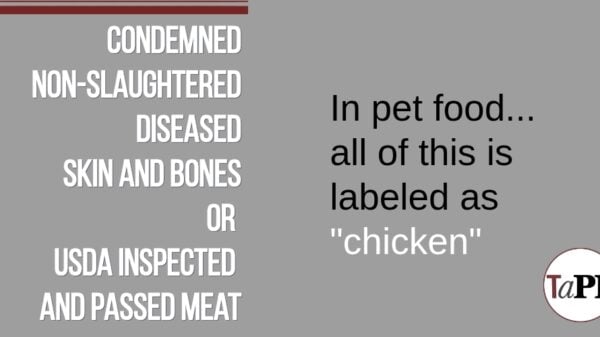

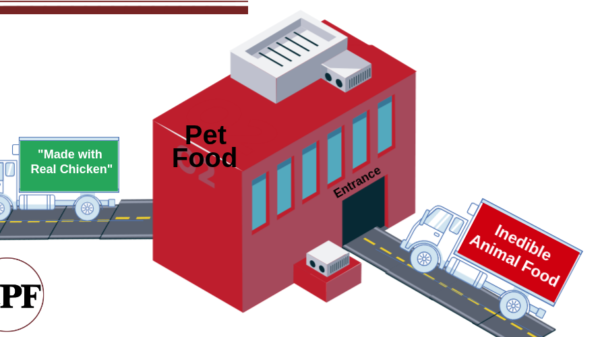






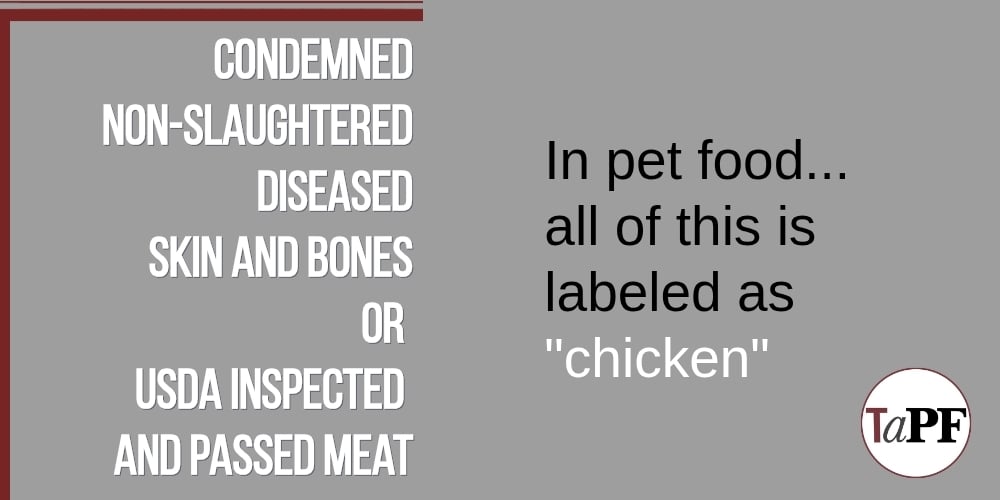
Background (one example): One food ingredient name – chicken. In human food chicken listed on the label is legally required to be USDA inspected and passed. Different parts of chicken – such as chicken wings, or chicken breast meat – are clearly labeled disclosing the type of chicken. But in a pet food, chicken can be anything from condemned/diseased meat, to dead/non-slaughtered chicken, to chicken bones and skin with little to no meat, to USDA inspected and passed chicken exactly like you purchase in the grocery. In a pet food, ALL classifications are labeled as ‘chicken’.
The reason one single ingredient – chicken – can vary so much in pet food is directly due to no Standard of Identity.
Standards of Identity (SOI) for food have been in place for decades. The FDA website states (bold added): “SOIs were first established in 1939 to help address economic adulteration that was occurring in the marketplace. For example, there were products that were represented as jams containing fruit, but the products contained little fruit (e.g., the SOI for fruit preserves and jams requires that products represented as jam contain a minimum amount of fruit). SOIs were developed to help protect consumers and promote honesty and fair dealing. SOIs have been established to ensure that the characteristics, ingredients and production processes of specific foods are consistent with what consumers expect.“
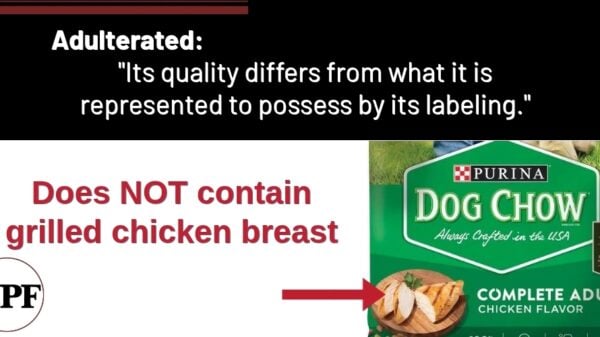
Regarding economic adulteration, the FDA states (bold added): “Economically motivated adulteration (EMA) occurs when someone intentionally leaves out, takes out, or substitutes a valuable ingredient or part of a food.”
Economic adulteration – the very reason FDA developed ingredient Standard of Identity – happens daily in pet food because SOIs do not exist for pet food ingredients. Pet food consumers are not protected the same way human food consumers are.
Prior to 1999, US laws existed for the FDA to establish pet food ingredient Standard of Identity. But those laws were deleted in January 1999, the FDA stated their reasoning for submitting the laws for deletion was the laws were “unnecessary”.
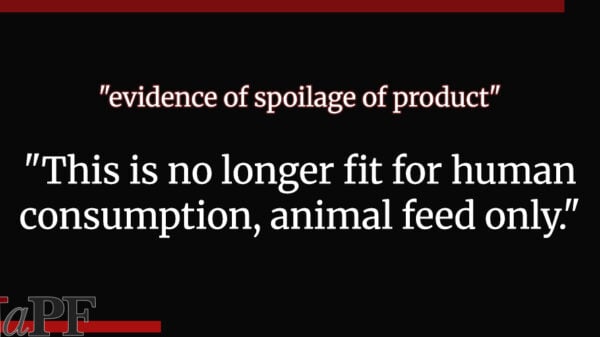
“Unnecessary” is simply not true. As far back as 1980 the FDA was fully aware that the pet food industry was utilizing highly inferior qualities of ingredients without disclosing that quality to the consumer. Originally published in 1980, the FDA made this statement in a Compliance Policy: “Pet food consisting of material from diseased animals or animals which have died otherwise than by slaughter, which is in violation of 402(a)(5) will not ordinarily be actionable, if it is not otherwise in violation of the law. It will be considered fit for animal consumption.” The FDA knew some pet foods were substituting condemned chicken for federally required USDA inspected and passed chicken without disclosure to consumers – the very definition of economic adulteration.
When the FDA deleted the opportunity to develop pet food ingredient Standard of Identity in 1999, they assured Congress if there was ever a need, the agency would take action to develop them. “Should FDA ever receive a request to develop an animal food standard regulation, the agency could determine whether procedural regulations are necessary and issue such procedures through the notice and comment rulemaking process.”
An official necessity to establish Standard of Identity for pet food ingredients came in 2004 when the first Human Grade Pet Food entered the market. With human grade pet food came undeniable public evidence all grades of pet food ‘chicken’ were not the same. Human grade pet foods were required (by FDA) to source ONLY USDA inspected and passed chicken. All other pet foods did not have that same requirement. Without a pet food Standard of Identity for (as example) chicken, feed grade pet food manufacturers were (and are today) allowed to source diseased condemned chicken and label it as ‘chicken’ on the pet food (the identical ingredient name to inspected and passed chicken in human grade pet food). Two very different ingredient qualities with identical names, misleading pet food consumers (economic adulteration).
But still…the FDA did not see the ‘necessity’. The agency took no action to protect pet food consumers.
To give you an estimate of how much condemned chicken goes into pet food, the USDA reported that in just three months (April 2025 – June 2025), more than one million poultry carcasses were condemned. At an estimated 6 pounds each, that is more than 6 million pounds of condemned poultry meat in just three months allowed to be disposed of into pet food without disclosure to consumers.
In 2007, the FDA received a VERY official request to establish pet food ingredient standards, this time directly from Congress.
The 2007 pet food recall was the result of a lack of standard of identity of pet food ingredients. Unscrupulous vegetable protein ingredient suppliers (such as wheat gluten) added toxic melamine and cyanuric acid to pet food ingredients to make them appear as a higher quality/higher protein percentage ingredient. No standard of identity was in place at the time holding a pet food ingredient supplier to a safety or quality standard. The result was thousands of pets (some estimate hundreds of thousands of pets) died or suffered permanent kidney damage.
Congress took action after this deadly pet food recall, writing and passing the Food and Drug Administration Amendments Act which included Section 1002 Ensuring the Safety of Pet Food. These new laws required the FDA to (in part) establish by regulation “ingredient standards and definitions with respect to pet food.” And Congress gave the FDA a deadline to complete this pet food safety work, pet food ingredient standards were required to be completed by September 2009.
But…the FDA never completed this requirement. The deadline established by Congress did not seem to matter to FDA, year after year passed, and the FDA did not develop pet food ingredient standards.
Then in 2018, Senator Rand Paul of Kentucky submitted an addendum to an unrelated bill that completely deleted our pet food ingredient standard laws. Thanks to Senator Rand Paul’s addendum, the FDA no longer had an obligation to protect consumers through pet food ingredient standards.
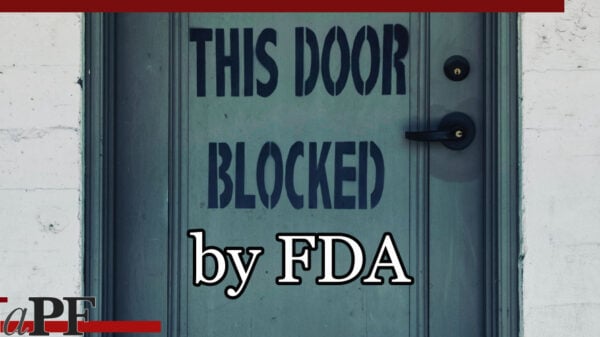
It is also significant to note, the FDA has NEVER informed the public to what quality of ingredients the agency allows in pet food. As we have evidenced, the FDA knows diseased animals and condemned animal material goes into pet food, but they have NEVER told the pet owning public. The FDA has never issued a public statement that would help pet owners discern between quality of ingredients in pet food. Never.
It is clear, the FDA does not want pet owners to know what they are buying in pet foods. The FDA’s lack of action continues to keep pet owners in the dark to what they are purchasing and continues to provide feed grade ingredient pet food manufacturers the opportunity to get away with economic adulteration (profit from misleading consumers).
What can you do?
It is important for the FDA to hear from pet food consumers. Not because they actually listen to us (they don’t). Your message to FDA is important because your request to FDA will become an official record evidencing FDA is ignoring the need for pet food ingredient Standard of Identity.
Send the FDA Center for Veterinary Medicine an email asking the agency to establish Standard of Identity for pet food ingredients. Tell FDA that without ingredient standards, you can be/are easily deceived by pet food labels. FDA email: AskCVM@fda.hhs.gov
Send a message to your state and federal elected officials (especially those that might want your vote next week). Tell your elected officials the FDA is refusing to establish Standards of Identity for pet food ingredients which allows economic adulteration to occur.
On a good note, every pet food that includes the words Human Grade on the label and every pet food that purchases 100% human edible ingredients are meeting legally required Standards of Identity. These companies are abiding by federal and state laws by using true food ingredients (‘chicken’ as you know chicken).
Susan Thixton
Pet Food Consumer Advocate
TruthaboutPetFood.com
Association for Truth in Pet Food
Find Healthy Pet Foods in Your Area Click Here

The 2026 List
Our trusted ‘list’ of pet foods. Click Here to learn more.

The 2026/27 Treat List
Susan’s List of trusted pet treat manufacturers. Click Here to learn more.

Association for Truth in Pet Food is a stakeholder organization representing pet food consumers at AAFCO and with FDA. Your membership helps representatives attend meetings and voice consumer concerns with regulatory authorities. Click Here to learn more.






Carole
October 26, 2026 at 3:14 pm
Boy oh boy, I’m so glad I somehow stumbled upon this website a couple of years ago. I was one of those pet parents who thought the various brands of kibble were perfectly fine food for our dogs! Thanks for educating us, and in doing so, we learn to appreciate the importance of quality ingredients in our beloved pets’ diet. For the first time in my dog mother’s life, our 3 y/o Doodle has zero medical issues. I also get her minimal vaccinations, only required rabies and bordatella to (hopefully) protect her from bouts of kennel cough. Also, no dog parks, too many people and dogs misbehave. 😱
Thanks for sharing your knowledge and experience with us, Susan.
👍🏼 🐶