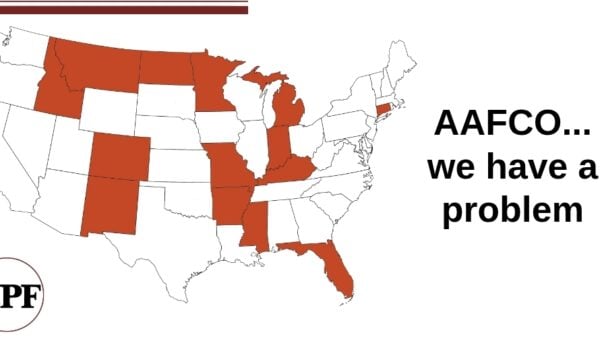



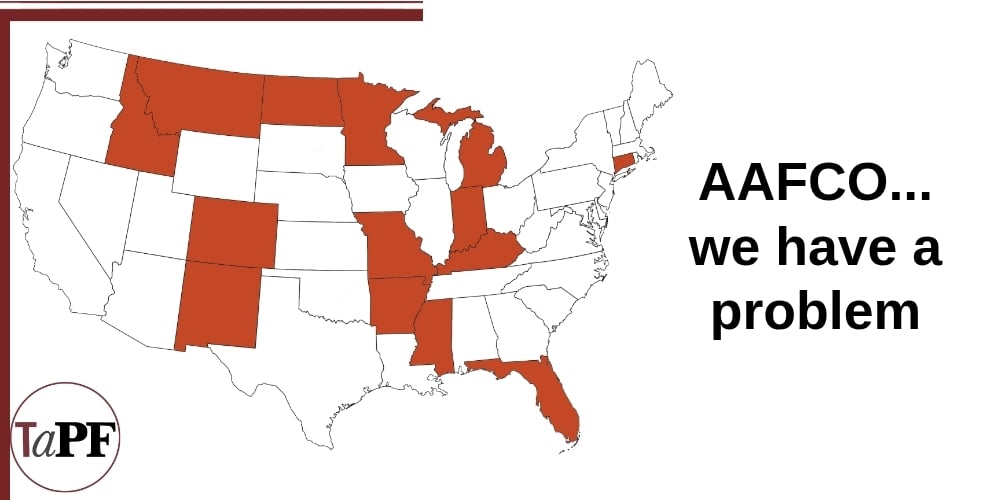
Fourteen US states have laws that directly conflict with AAFCO pet food ingredient definitions. In fact, if challenged in a court, it is likely many commonly used pet food ingredients would be deemed invalid by the court. This could result in many pet food ingredients having no definition in those 14 states, potentially resulting in the ingredients not being allowed in pet foods sold in those states.
We sent AAFCO the following message (which explains the problem):
Fourteen US states (Arkansas, Colorado, Connecticut, Florida, Idaho, Indiana, Kentucky, Michigan, Minnesota, Mississippi, Missouri, Montana, New Mexico, and North Dakota) have state laws that conflict with AAFCO ingredient definitions commonly used in pet food.
Such as the state of Missouri. State law: “266.180. Adulterated feed, what constitutes. — A commercial feed shall be deemed to be adulterated: (i) If it is, in whole or in part, the product of a diseased animal or of an animal which dies other than by slaughter which is unsafe within the meaning of section 402(a)(5) of the Federal Food, Drug, and Cosmetic Act;”
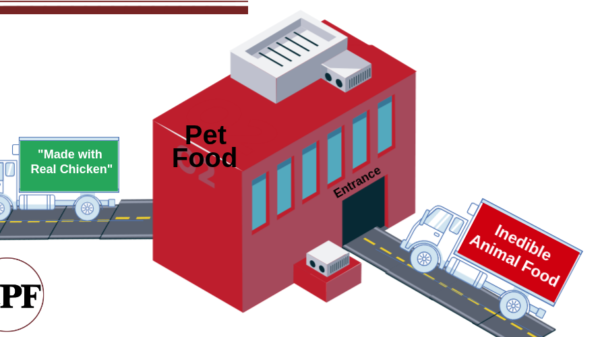
The AAFCO definitions of the following ingredients do not hold the requirement to be sourced from a slaughtered animal, directly in conflict with Missouri state law: Poultry by-product meal, Poultry by-products, Meat meal, Meat and bone meal, Animal by-product meal, Animal Digest. Without the requirement in the AAFCO definition to be sourced from slaughtered animals (as Missouri law requires), ingredient manufacturers are free to source non-slaughtered dead animals in their ingredients.
All AAFCO Animal Product definitions commonly used in pet food include the sentence “It shall be suitable for use in animal food.” Suitable for use in animal food is defined as (in part) “conforms to the Federal Food, Drug and Cosmetic Act unless otherwise expressly permitted by the appropriate state or federal agency.” Which means that diseased animals – directly in conflict with Missouri state law – could be “permitted” to be included in Animal Product ingredients.
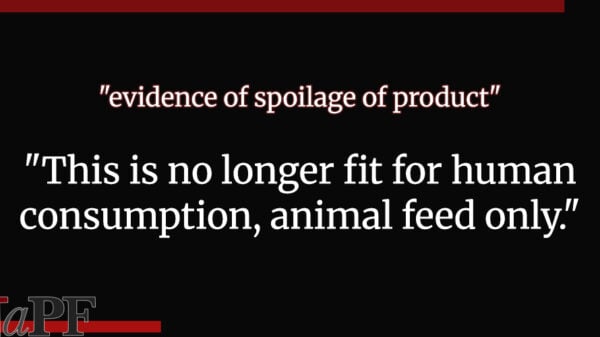
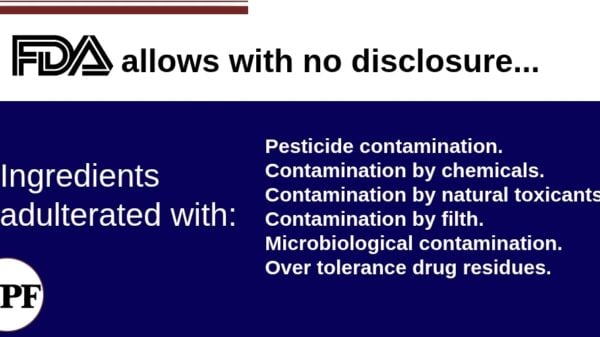
Missouri law states a commercial feed would be considered adulterated “If it consists in whole or in part of any filthy, putrid, or decomposed substance, or if it is otherwise unfit for feed.” Yet no AAFCO Animal Product definition makes this requirement as part of the legal definition (allowing filth and decomposition in ingredients directly in conflict of state law).
Again using Missouri as the example state, Missouri state law: “536.014. Rules invalid, when. — No department, agency, commission or board rule shall be valid in the event that: (2) The rule is in conflict with state law.”
If challenged, a Missouri court could easily rule that many AAFCO ingredient definitions are “in conflict with state law” and would be ruled as invalid.
All 14 states have similar laws. If challenged in any of the 14 states, courts would more than likely rule many AAFCO ingredient definitions conflict with state law and would invalidate the definitions.
It is concerning that many individuals from these 14 states voted to approve these ingredient definitions, participated on the Pet Food and Ingredient Definitions committees and even held high positions within AAFCO knowing their state laws conflicted with the AAFCO definitions – yet no one ever spoke up.
Again, if challenged, many commonly used pet food ingredients could be deemed invalid resulting in these ingredients being prohibited for use in pet foods (due to lack of legal definition).
We are asking AAFCO to immediately address this issue, before a serious problem for pet food consumers and industry occurs. AAFCO’s Animal Product ingredient definitions SHOULD be aligned with state laws. At the very least, the Animal Product ingredient definitions for the states Arkansas, Colorado, Connecticut, Florida, Idaho, Indiana, Kentucky, Michigan, Minnesota, Mississippi, Missouri, Montana, New Mexico, and North Dakota must be revised to fully align with state laws; include the requirements to be sourced from a slaughtered animal, a disease-free animal, and free from filth and decomposition. Please provide us a response to how AAFCO intends to proceed.
If/when AAFCO responds, it will be shared with pet owners.
Susan Thixton
Pet Food Consumer Advocate
TruthaboutPetFood.com
Association for Truth in Pet Food
Find Healthy Pet Foods in Your Area Click Here

The 2026 List
Our trusted ‘list’ of pet foods. Click Here to learn more.
The 2026/27 Treat List
Susan’s List of trusted pet treat manufacturers. Click Here to learn more.

Association for Truth in Pet Food is a stakeholder organization representing pet food consumers at AAFCO and with FDA. Your membership helps representatives attend meetings and voice consumer concerns with regulatory authorities. Click Here to learn more.