






Vital Essentials pet food has begun treating their pet foods with irradiation. On a FAQ page, the pet food manufacturer states they have “implemented E-Beam Technology to eliminate harmful pathogens using electricity.“
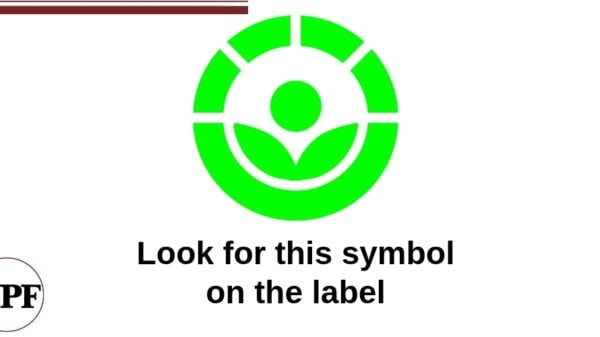
Packaged foods (pet or human foods) that have been treated with irradiation are required to display the radura symbol (below) on their label and/or the label must include a statement “Treated with radiation” or “Treated by irradiation”.

Is it safe?
The FDA and a white paper published by the irradiation industry says yes, the process is safe.
But many pet owners will remember what happened to cat food treated with irradiation in Australia years ago (2008). When Orijen pet food began importing cat food into Australia, the foods were treated with irradiation resulting in death and paralysis of cats. The Australian Parliament stated: “an irradiation treatment applied to pet food for quarantine purposes, may have been a factor in causing depletion of vitamin A, and the formation and release of free radicals in the imported Orijen brand pet food.”
But…there is a difference between the irradiation of the Orijen pet food in 2008 and today’s irradiation of Vital Essentials pet food. The difference is the type of irradiation. Australia used gamma irradiation, Vital Essentials is using “e-beam” irradiation. Vital Essentials states: “Our validation work shows the food maintains nutritional integrity after treatment.”
And…jerky treats imported from China, which were directly linked to illness in dogs, were also treated with irradiation (unknown if treated by gamma or e-beam irradiation). During the FDA investigation of pet illnesses and deaths, the FDA performed testing of the jerky treats including “markers of food irradiation (such as 2-alkylcyclobutanones).” In an update to consumers during the height of jerky treat related pet deaths, the agency stated “Currently there are no validated methods to determine the dose of radiation that was used to ensure the product was properly irradiated.”
If there is no validated method to determine the dose of radiation – should anyone (human food or pet food) be using it? (Cart before the horse?)
Why is irradiation being used on pet foods and treats?
The FDA issued a zero tolerance policy for pathogenic bacteria in pet food in 2013. Meaning, in 2013 the FDA decided that pet food manufacturers must produce pathogenic bacteria free pet foods or risk FDA recall.
Irradiation is one method manufacturers use to control pathogenic bacteria. HPP (high pressure processing) is another method. The FDA preference is cooking/heat treatment.
Has the FDA zero tolerance approach been effective?
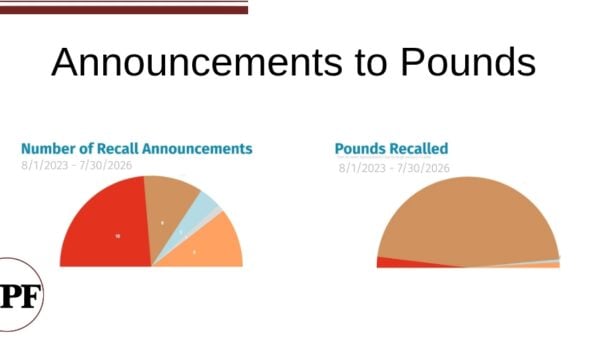
Below is a chart that provides the pounds of meat/poultry recalled (by USDA), the pounds of raw pet food recalled (by FDA), and the pounds of kibble pet foods recalled (by FDA) for Salmonella, Listeria, and E coli combined. Note: the USDA has a zero tolerance for E coli in human food meats, but not for Listeria or Salmonella – the FDA has a zero tolerance for all three pathogens in pet food.
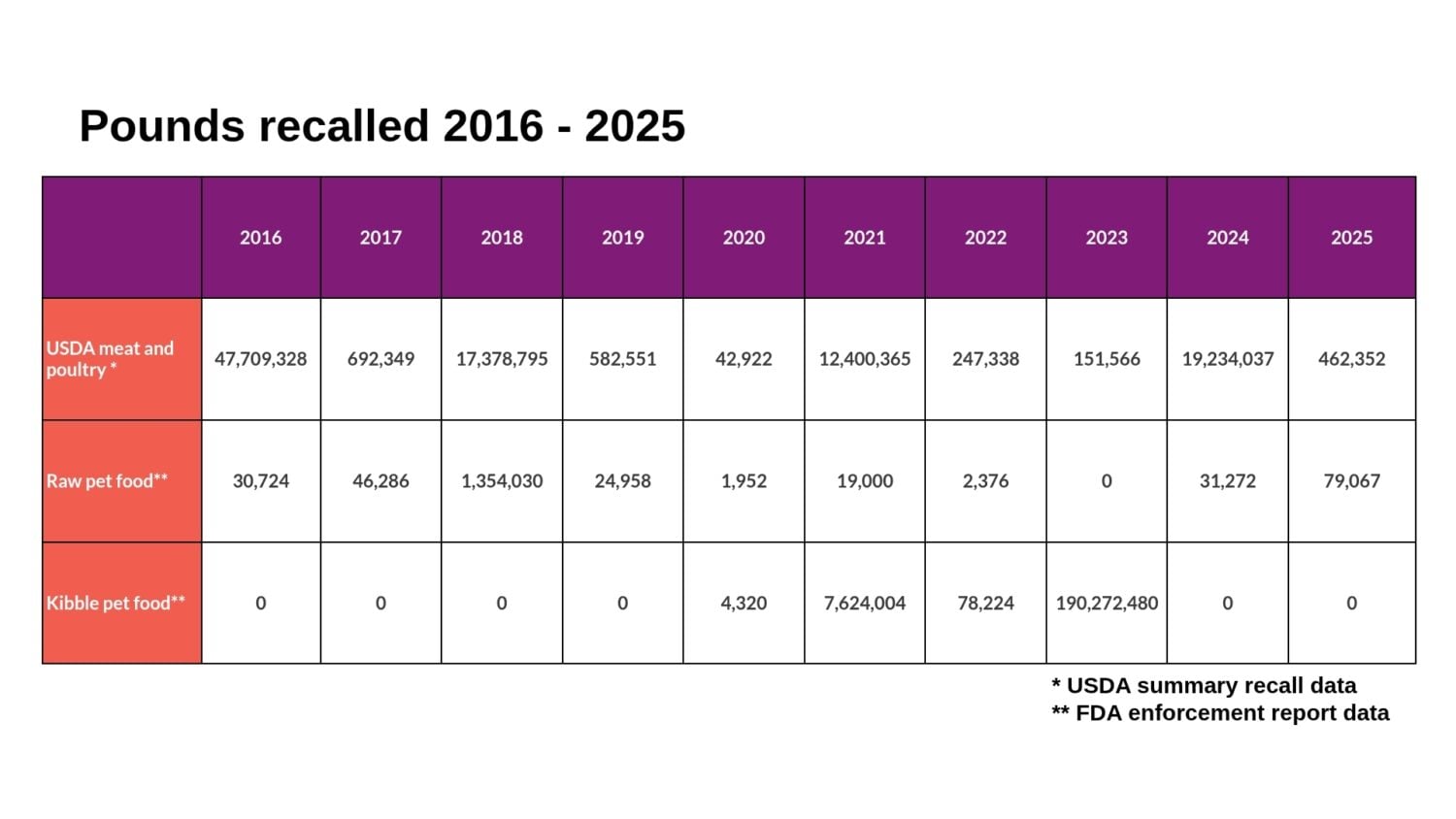
With all of the efforts to control these pathogens in food and pet food…do you see any downward trend in pounds recalled over the past ten years? Is zero tolerance making any significant difference?
Pet food kibble is processed with FDA’s preference, an official ‘kill step’ (cooking), yet millions of pounds of kibble have been recalled over ten years for pathogenic bacteria contamination.
It isn’t working.
Shouldn’t regulatory authorities go back to the drawing board and perhaps look at the source of pathogenic bacteria in food – and control it at the source?
One more thing…just because a pathogenic bacteria is killed by some type of kill step, does NOT mean the food is safe to consume.
Endotoxins are ‘toxins’ that are released on bacterial death. Endotoxins are produced by Gram-negative bacteria such as Salmonella and E. coli. Endotoxins are “moderately toxic; fatal to animals in large doses.”
Specific to endotoxin exposure to pets, Veterinarian and Professor Emeritus, University of California, Davis, School of Veterinary Medicine Dr. Donald R. Strombeck stated “Endotoxin entering the body is carried to the liver where it is inactivated. Increased endotoxin levels can damage the liver. Moreover, when the amount of endotoxin reaching the liver is normal, the presence of another potential toxin can interact with endotoxin to damage the liver. The other substances are not necessarily toxins. They include vitamin A, copper and iron, and many drugs. Thus, any level of endotoxin can damage the liver. Exposure to endotoxin should be minimized as much as possible.”
The higher the level of Salmonella in an ingredient before a kill step results in higher endotoxin levels in the finished pet food. Endotoxin levels in pet food is a subject the FDA Center for Veterinary Medicine refuses to address (we have tried on numerous occasions).
Again…shouldn’t the focus be to control pathogenic bacteria at the source?
If your pet’s food or treat is treated with irradiation, ask the manufacturer what type of irradiation was used and ask for recent full nutritional profile test results (after irradiation treatment).
Susan Thixton
Pet Food Consumer Advocate
TruthaboutPetFood.com
Association for Truth in Pet Food
Find Healthy Pet Foods in Your Area Click Here

The 2026 List
Our trusted ‘list’ of pet foods. Click Here to learn more.

The 2026/27 Treat List
Susan’s List of trusted pet treat manufacturers. Click Here to learn more.

Association for Truth in Pet Food is a stakeholder organization representing pet food consumers at AAFCO and with FDA. Your membership helps representatives attend meetings and voice consumer concerns with regulatory authorities. Click Here to learn more.



Shelly
September 22, 2026 at 2:43 pm
The bully sticks we have been buying have been irradiated. I think it eliminates the smell.
Heather Dauterive
September 22, 2026 at 3:28 pm
This is just another way for them to cash in on vet care. The food is cheaply made, the prices go up, the pets get sick, they go to the vet, they keep eating the food, more vet visits. Vicious cycle. Does anyone have a home recipe for cat food?