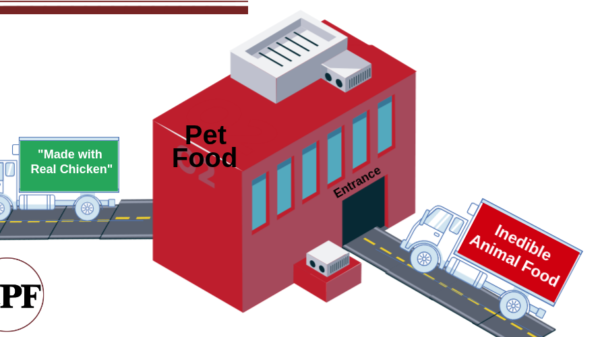


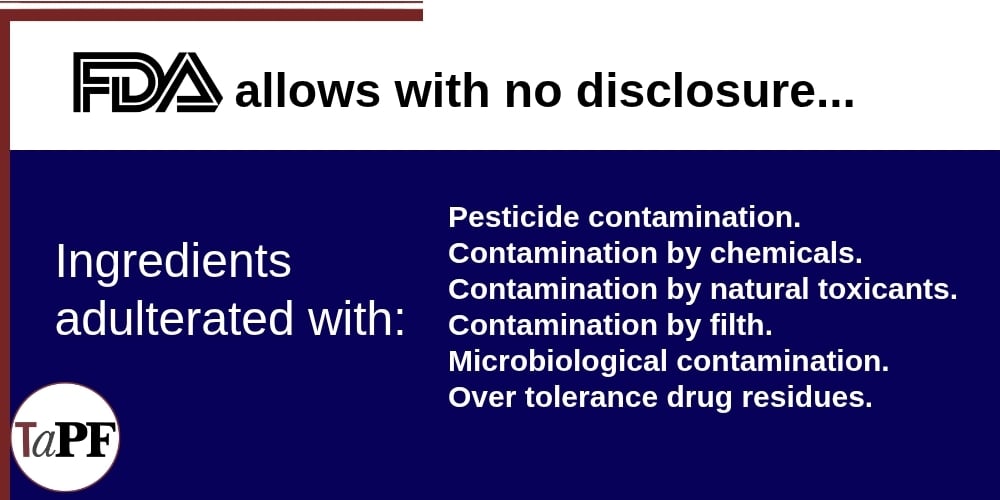
The FDA has issued multiple Compliance Policies that informs industry what laws the agency will or will not enforce. In each of the Compliance Policies below, the FDA is allowing adulterated food to be disposed of into pet food/animal feed. And in each Policy the agency requires the adulterated foods to be approved (by FDA) first – before disposal into pet food/animal feed.
In CPG Sec. 675.100 Diversion of Contaminated Food for Animal Use the agency gives this as background information:
“FDA does not object to the diversion to animal feed of human food adulterated with rodent, roach, or bird excreta. However, since rodent, roach, or bird excreta are vectors for microorganisms deleterious to the health of animals, including such things as parasite eggs, salmonella, leptospira, or other pathogenic organisms, diversion has not been authorized except following a heat treatment appropriate to destroy such organisms.”
And the FDA Policy regarding the Diversion of Contaminated Food for Animal Use states this:
“Diversion of rodent, roach, or bird contaminated food for animal feed use, whether pursuant to a court order or a voluntary action, requires heat treatment to destroy pathogenic organisms. The *Center for* Veterinary Medicine (HFV-236) should be contacted on a case-by-case basis concerning suitability of proposed treatment, whether pursuant to a court order or a voluntary action.”
With the above Compliance Policy, the FDA allows food that has legally been classified as adulterated – contaminated with rodent, roach or bird feces – to be disposed of into animal feed. The FDA requires the agency to be notified in advance to approve the ‘treatment’ to destroy “such things as parasite eggs, salmonella, leptospira, or other pathogenic organisms” (that will soon become pet food or animal feed).
In CPG Sec. 675.300 Moisture Damaged Grain the FDA Center for Veterinary Medicine (CVM) provides this background information:
“In the past CVM has authorized the diversion of moisture-damaged grain as well as other food materials for animal feed use. Such authorization has always had to take into consideration the nature and source of the water since fires from grain elevator explosions are often quenched using sea water or river water which may contain sewage, pathogenic organisms, chemical wastes or other toxic substances. Similar problems are posed when foodstuff is flooded following hurricanes or other natural disasters. Even more serious is the mold growth which may occur in wet foods.”
And this is the FDA CVM Policy regarding contaminated grain:
“Moisture-damaged and/or moldy foodstuffs may be considered for conversion to animal feed use. However, in each case authorization will be made by *CVM* in consultation with *CFSAN* based upon information concerning the nature and source of the moisture and the actual or suspected type of contamination and whether the damaged material may be rendered safe for use as animal feed.” (CFSAN stands for a division of FDA, Center for Food Safety and Applied Nutrition.)
Again, in each case of moisture damaged grain (or “moldy foodstuffs”), the FDA requires the agency be notified/consulted with in advance of the damaged grain being diverted to pet food/animal feed.
In CPG Sec. 675.200 Diversion of Adulterated Food to Acceptable Animal Feed Use, the FDA provides this information as background:
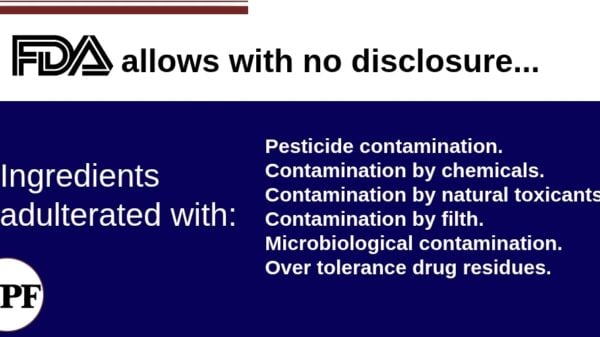
“In the past, FDA has authorized the salvage of human or animal food considered to be adulterated for its intended use by diverting that food to an acceptable animal feed use. Most of these instances have involved, but have not been limited to, the interpretation of section 402(a)(3) and (4) of the Federal Food, Drug, and Cosmetic Act to allow different standards for foods intended for human use vs. food intended for animal use, e.g., defect action levels for filth in a food intended for human use but not for the same food intended for animal feed use. Diversion requests, however, have also included USDA detained meat and poultry products contaminated with drug or other chemical residues, as well as food and feed under voluntary industry recall or quarantine that may be considered adulterated for their intended use(s).”
This is the FDA Policy regarding the disposal of adulterated food into pet food/animal feed use:
“Diversion requests will be handled on an ad hoc basis. The *Center* will consider the requests for diversion of food considered adulterated for human use in all situations where the diverted food will be acceptable for its intended animal food use. Such situations may include:
- Pesticide contamination in excess of the permitted tolerance or action level.
- Pesticide contamination where the pesticide involved is unapproved for use on a food or feed commodity.
- Contamination by industrial chemicals.
- Contamination by natural toxicants.
- Contamination by filth.
- Microbiological contamination.
- Over tolerance or unpermitted drug residues.”
With this FDA Policy, the agency again requires the consignee of the adulterated foods to notify the agency in advance of diversion to pet food/animal feed. Below is some of the information the agency requires with each adulterated food diversion request.
- “Name and address of the requestor, and the name of the owner of the subject articles.
- The precise physical location of the product.
- The reason(s) the articles are considered adulterated for their originally intended food uses.
- The levels, on a lot-by-lot basis, of any adulterant; all analytical data regarding such levels of an adulterant, and the methodology used in determining the levels of the adulterant.
- The name and address of the proposed consignee.
- The reconditioning or denaturing procedure, if any.
- The intended use of the diverted food. This will include complete description of the class of animals involved, whether they are food or non-food producing, the part of the country in which the food will be used, and all assurances that have been secured that indeed the food will be used as agreed.“
The FDA knows EXACTLY which pet food manufacturers include adulterated ingredients contaminated with all types of substances. The FDA knows EXACTLY which livestock feed manufacturers include adulterated ingredients.
But the FDA doesn’t tell you.
The FDA does not require the manufacturer to tell you either. The ingredient list gives you no clues if the chicken includes drug residues, or the grain includes pesticides or sewage.
On September 17, 2026, we filed a Freedom of Information Act (FOIA) request with FDA asking for all of the approved adulterated food diversion requests from 1/1/2020 through 9/17/2026. Our request included the name of the consignee in each diversion request (which manufacturers purchased adulterated foods). We will share all information received when it is provided by FDA.
However, we have been made to wait over 5 years for previously submitted FOIA requests. Knowing the agency does not want the public to know this information, we assume this will take years for FDA to provide. But it will be interesting to see if the consignee information is provided or not. Will FDA protect industry, or will they be transparent with consumers?
Susan Thixton
Pet Food Consumer Advocate
TruthaboutPetFood.com
Association for Truth in Pet Food
Find Healthy Pet Foods in Your Area Click Here

The 2026 List
Our trusted ‘list’ of pet foods. Click Here to learn more.
The 2026/27 Treat List
Susan’s List of trusted pet treat manufacturers. Click Here to learn more.

Association for Truth in Pet Food is a stakeholder organization representing pet food consumers at AAFCO and with FDA. Your membership helps representatives attend meetings and voice consumer concerns with regulatory authorities. Click Here to learn more.


Carol Chakeropulos
September 18, 2026 at 12:01 pm
… and it continues. So shameful. That is why I thank you, Susan, for your food list. I will never feed anything to my dog but Evermore dog food from your list which checks all the boxes! So worth the money. I trust them totally. Thank you again for all you do, Susan.
Take care.
T Allen
September 18, 2026 at 12:38 pm
You said “we submitted”, Susan, and I started laughing. We will never get an answer to that FOIA. Only way that will happen is if there is a civil war, we win and decide to join the European Union. They have strong regs and enforce them. My guess is AI will destroy humanity before you hear back. (Lol, just kidding, AI can’t destroy humanity) Maybe it will decide poisoning animals is evil and shut down the FDA? 😉
sara
September 18, 2026 at 1:00 pm
i wouldn’t bet on the EU long term. chances are they will disintegrate. i wish pet owners would stick to the list susan provides and updates regularly and/or make their own from ingredients they buy. it ain’t rocket science. it is a lot harder to ignore the disappearance of the cash cow aka pet owner. we consumers have the power, we just need the will and backbone to use it.