










To start things off on shaky ground, the AAFCO official agenda included a meeting notification of an industry trade group.

The AFIA meeting – an industry trade association meeting – should NOT have been listed in a regulatory meeting agenda.
AAFCO is an independent organization whose members are state feed officials, government employees. The work done by AAFCO results in state laws that govern pet food and animal feed. AFIA on the other hand is a trade association, representing the wants and needs of industry. While these two organizations certainly work together, there needs to be a very solid line separating the two organizations. Each organization has a foundational difference in what they do and who they represent. When AAFCO blurs that line between industry and regulatory by listing an industry meeting on the agenda for a regulatory meeting – trust in AAFCO suffers. It makes you question what other ‘things’ AAFCO is doing as favors for industry?
Even though FDA and AAFCO no longer work together as they did in the past, FDA still attends these meetings. AAFCO stated 36 FDA representatives were in attendance.
FDA formerly provided the scientific review of new animal feed/pet food ingredients. Now, FDA has a separate animal feed/pet food ingredient approval process from AAFCO’s. In a discussion regarding AAFCO’s ingredient approval process, a state feed official from Texas shared his state’s laws require a ‘risk assessment’ for each new animal feed ingredient, he stated AAFCO’s ingredient approval process does not include risk assessment. AAFCO responded sharing their ingredient approval process includes ‘safety data’ for each new ingredient. Is there a difference between a ‘risk assessment’ and ‘safety data’? AAFCO didn’t think so, AAFCO felt they were the same thing. Texas did not agree.
In a discussion on potentially editing the definitions of meat and bone meal and meat meal, the disclosure was made that meat meals generally consist of 28% ash. Ash content is an indicator of how much bone is included, and represents the mineral content of an ingredient (or pet food). It was also disclosed that meat and bone meal ingredients can be as high as 45% ash.
The keynote speaker at this meeting was Michael Johnson of BSM Partners – a pet food industry consulting firm. While Mr. Johnson gave a very good presentation, made some good points – he did so by being somewhat insulting to pet food consumers.
He gave the example that people drive a car without knowing exactly how the brakes work, but pet owners call manufacturers of pet food demanding to know how long the pet food was cooked and at what temperature. He wasn’t intentionally trying to belittle pet owners (although he kept repeating ‘pet owners are weird’), but at times it was clear he did not have the understanding of pet owners wants and needs (even though he thought he did).
He did correctly emphasize that pet owners want to be able to trust their pet food, it’s safety. And he also correctly pointed out to AAFCO that pet owners want to understand and trust their regulators.
We see the problem of trust in pet food safety a little differently. Using Mr. Johnson’s analogy, people who drive cars might not understand exactly how the brakes work, but they do know the laws of the road. In comparing this to pet food consumers, pet owners have been denied public access to the road rules (because AAFCO owns and copyright protects the regulations). Can you imagine driving a car without any knowledge of the road rules? Considering that every single ingredient in pet food has its own unique definition that is often dramatically different from the same ingredient in human food…think about driving that car when one time a STOP sign means stop, and in the next block the STOP sign means go. And the driver of the car isn’t told which is which.
Now you are getting closer to understanding what pet owners have to go through to trust their pet food. Don’t blame pet owners for asking questions, trying to learn the road rules.
During the Ingredient Definitions Committee Meeting, a proposed description of the term HPP was discussed. The following is only a draft definition, it is still in discussion.
“High Pressure Pasteurization (Process). A non-thermal preservation technique that inactivates microorganisms through the application of intense pressure. When properly applied, the process can achieve at least a 6-log reduction of relevant pathogens. The manufacturer must validate the pathogen-reduction performance of the process for their specific product matrix and must document the parameters necessary to consistently achieve the validated 6-log reduction.”
There was much discussion on this description of HPP, including from FDA who did not want the word ‘Pasteurization’ used, they preferred ‘Processing’. This discussion went down a rabbit hole into defining what ‘slow cooked’ means and other labeling terms. Some felt these terms should not be defined (such as slow cooked), others felt they should. We will have to wait for future meetings to see where this lands.
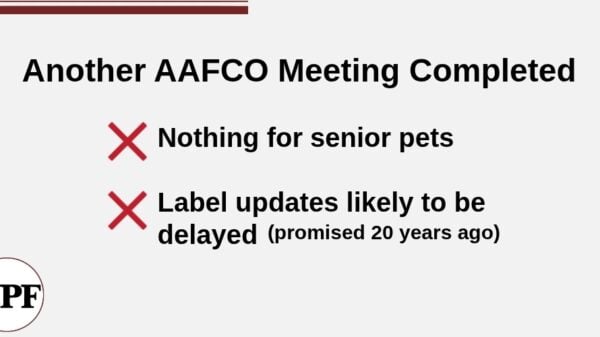
During the Pet Food Committee meeting, a presentation was provided by Dr. Claire Timlin, of Four Rivers Kennels (a laboratory kennel that in part performs feeding trials). She provided research to AAFCO – both research from the Four Rivers Kennels and published research – evidencing the nutritional needs of senior pets (her presentation’s emphasis was on dogs). As example, she provided research evidencing that a senior dog needs 1.5 times the amount of protein than an adult dog. She showed evidence that pet foods labeled for senior dogs varied dramatically in protein amounts – emphasizing the need for AAFCO to take some type of action to protect senior pets from potentially misleading marketing. And she suggested that research shows nutrient profiles (the nutritional requirements) for senior pets should be altered in a way that seniors get less calories while still receiving all of the required nutrients.
Two things…
- Europe has had for several years specific nutritional profiles for less active pets (such as senior pets). European pet foods have the ability to formulate a pet food that contains less calories to meet the needs of less active pets (such as senior pets) while still providing all nutrients to those pets. But not here in the US.
- This is EXACTLY what Steve Brown, Dr. Karen Becker, and myself presented to FDA several years ago (the problem of less active pets nutritional profiles). Although we clearly evidenced the need, our plea for action fell on deaf ears. FDA did nothing.
It seemed AAFCO was willing to open the door to potentially defining a nutrient profile specific to senior pets, but then FDA shut it down. One FDA representative openly stated she wasn’t sure a nutritional profile to benefit senior pets/less active pets was necessary.
They did agree to talk about it more, form a working group to talk about (ONLY talk about) what they should do in the future. Which probably delays what is currently needed in US pet food for several years.
Personal opinion: While Europe progressively moves forward updating their nutrient profiles, AAFCO and FDA remains stagnant – almost making the existing US pet food regulations obsolete. Our pets do NOT benefit from stagnant decision makers/obsolete regulations, but industry benefits greatly selling misleading claims to unknowing pet owners with no regulations to stop them.
Susan Thixton
Pet Food Safety Advocate
Author Buyer Beware, Co-Author Dinner PAWsible
TruthaboutPetFood.com
Association for Truth in Pet Food
Find Healthy Pet Foods in Your Area Click Here

The 2026 List
Our trusted ‘list’ of pet foods. Click Here to learn more.

The 2025/26 Treat List
Susan’s List of trusted pet treat manufacturers. Click Here to learn more.

Association for Truth in Pet Food is a stakeholder organization representing pet food consumers at AAFCO and with FDA. Your membership helps representatives attend meetings and voice consumer concerns with regulatory authorities. Click Here to learn more.



Midnight Hunter
January 22, 2026 at 10:30 pm
Oh wow, I’m 50 minutes early. I just happened to come upon this as I was scrolling the site, hah.
It seems that pet food in Europe has one thing going for them at least, compared to the US; despite the Purina pres. being in charge of regulations, I’ve recently found out.
T Allen
January 23, 2026 at 5:22 pm
Thanks Susan! Once again pet owners are reminded that the Fed Gov doesn’t care. Big surprise about TX though! No, safety and risk are NOT the same and I’m glad TX knows that! Sounds like consumers are making progress in some areas. I agree with FDA pasteurization is not the correct term. Pasturization means that the product can’t make you sick. A 6 log reduction could still leave enough pathogens to cause illness. I’ve seen lab tests with 12+ log pathogen levels! Will DR Timlin’s report be made public, I hope? Sounds like once tariff’s are lifted, in about a month hopefully, it’ll be time to start investigating buying European brands of dog food. That comment from the FDA rep is bizarre. I suspect FDA is under orders not to spend money and is likely investigating ways to get out from dealing with animal regulations completely. Time will tell.
Bonnie S Morris
January 24, 2026 at 12:51 pm
It sees very strange for anyone making decisions regarding our pet’s food that we Pet Owners Are referred to as “Wierd”. What’s that about? I certainly agree that our government doesn’t care about us or our pets. It’s all about the $$$$.