








Recently a pet owner shared with us a Facebook post where a veterinarian bashed human grade pet foods.
“‘Human grade’ is an unregulated marketing term that indicates the facility the food was processed in – not the quality of the ingredients, not the nutritional adequacy of the diet, not whether your dog should be eating it. A diet can be ‘human grade’ and still be wildly unbalanced and unsafe.”
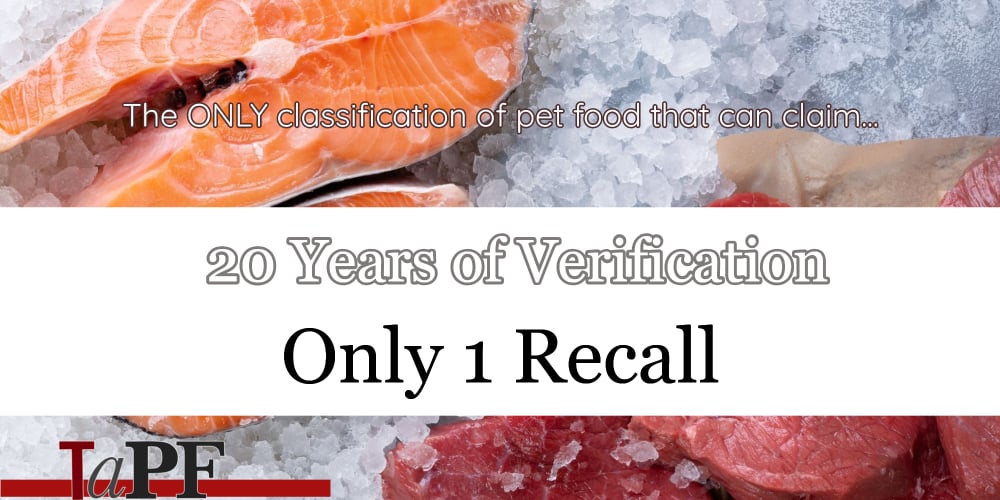
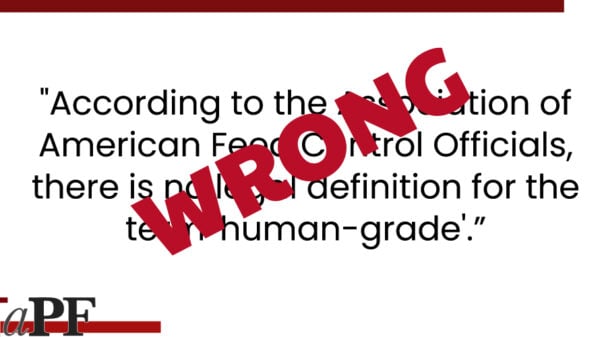
#1. Human grade is NOT an “unregulated marketing term”. It is legally defined and has been a verified standard of quality pet food for almost 20 years.
#2. Human grade pet food most definitely assures quality of ingredients. The legal definition and the legal standard of human grade pet food requires all ingredients to be human edible.
#3. ANY style of pet food can be “wildly unbalanced and unsafe”. As example, in 2019 Hill’s Pet Food recalled more than 10 million pounds of (feed grade) pet food due to excess vitamin D. To current day, not one human grade pet food has issued a recall due to being unbalanced. The ONLY recall that has been issued for a human grade pet food (meeting all requirements of the human grade pet food standard) was The Honest Kitchen Pet Food in 2013 for Salmonella contamination, 50 thousand pounds of pet food was recalled.
Unfortunately, this veterinarian is not the only one that is unfamiliar with pet food regulations resulting in bad advice to pet owners. Here are some facts to better equip yourself to help educate uninformed individuals.
History of Human Grade Pet Food
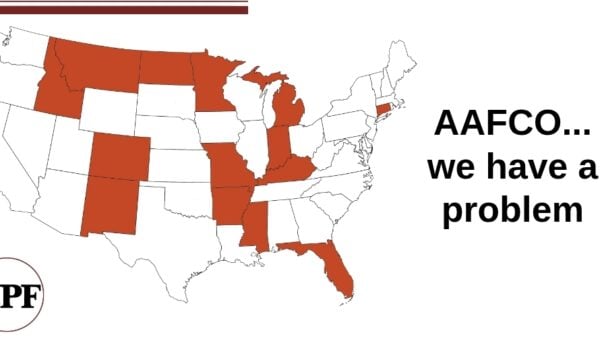
The classification of Human Grade pet food was originally approved, standardized, and verified by the FDA. Almost 20 years ago (2007), The Honest Kitchen pet food was the first commercial pet food to label its products as human grade. In 2015, the FDA passed the human grade verification process onto State Feed Officials which led to AAFCO (the Association of American Feed Control Officials) developing a legal definition of human grade pet food along with a standard for verification. AAFCO originally defined Human Grade pet food in 2016, adding some minor tweaks to the human grade standard in 2022.
The current legal definition of Human Grade pet food:
“Human Grade: Every ingredient and the resulting product are stored, handled, processed, and transported in a manner that is consistent and compliant with regulations for current good manufacturing practices (cGMPs) for human edible foods as specified in 21 CFR (Code of Federal Regulations) Part 117.”
The current legal standard for Human Grade pet food can be accessed here.
In simple terms…
A pet food labeled as Human Grade is verified by regulatory authorities to include 100% human edible ingredients (including any supplements) and manufactured according to human food safety standards. Complete and balanced human grade pet foods must meet the same nutritional requirements as any other pet food (such as Adult Maintenance or All Life Stages).
Feed Grade
At the same time AAFCO was defining Human Grade pet food, the organization also defined Feed Grade.
The current legal definition of Feed Grade:
“Feed Grade: Material that has been determined to be safe, functional and suitable for its intended use in animal food, is handled and labeled appropriately, and conforms to the Federal Food, Drug and Cosmetic Act unless otherwise expressly permitted by the appropriate state or federal agency (Suitable for use in animal feed).”
It is significant to note that human grade pet foods are required by regulation to abide by the same federal food safety laws as human food. With feed grade pet foods on the other hand, per the AAFCO legal definition – ingredients are directly allowed to violate federal law; “conforms to the Federal Food, Drug and Cosmetic Act unless otherwise expressly permitted by the appropriate state or federal agency.”
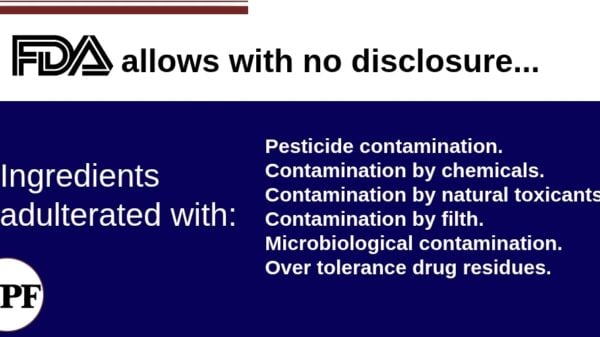
The ‘permission’ to violate federal laws mentioned in the legal definition of feed grade is in part due FDA’s enforcement discretion of pet food. Stated by Dr. Steven Solomon, Director FDA Center for Veterinary Medicine; “We do not believe that the use of diseased animals or animals that died otherwise than by slaughter to make animal food poses a safety concern and we intend to continue to exercise enforcement discretion.” (Source: Final Response Letter from FDA CVM to Association for Truth in Pet Food.)
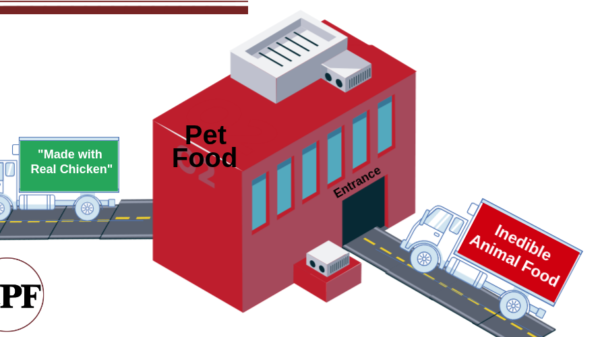
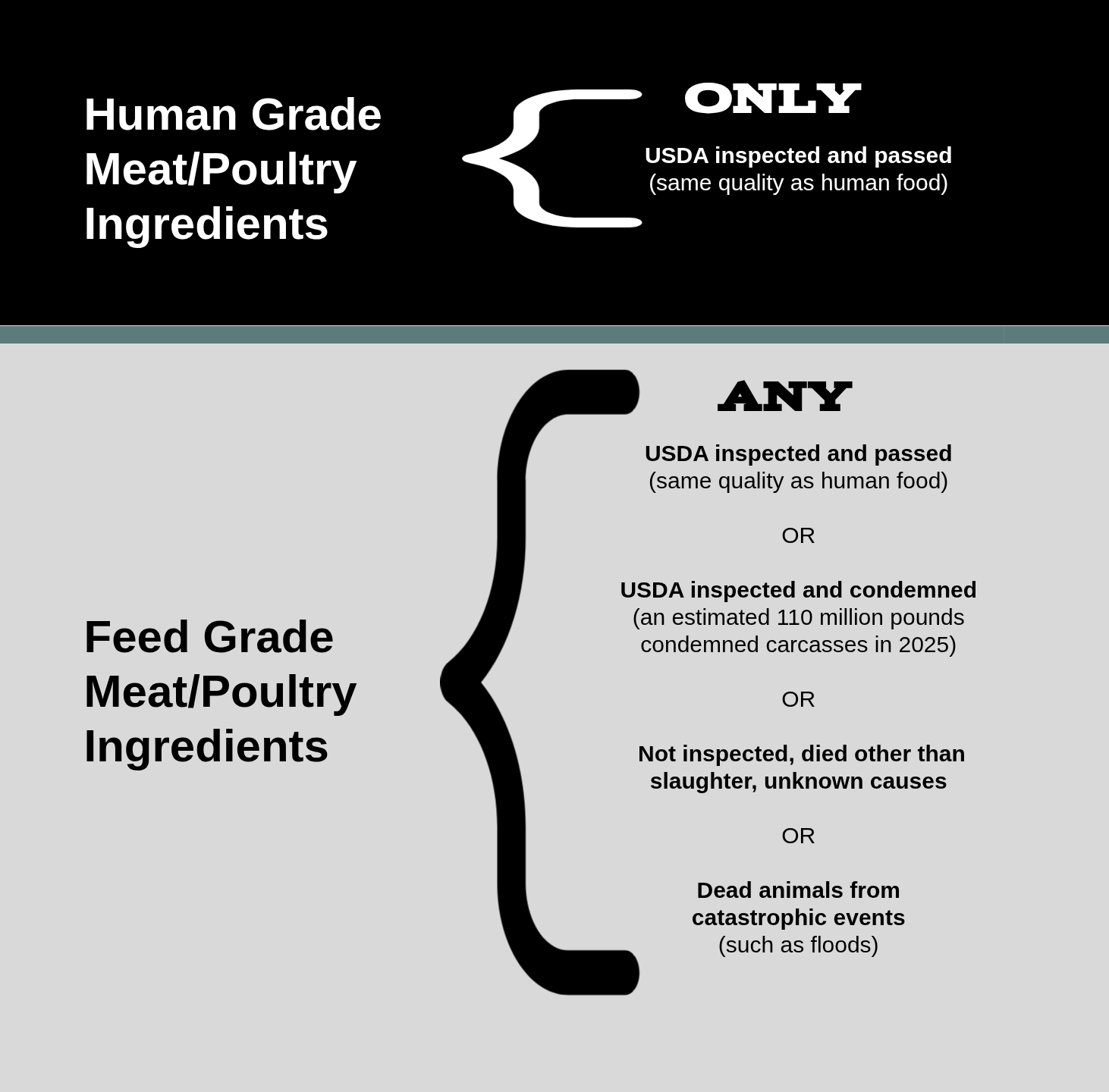
In other words, feed grade pet food animal sourced ingredients can range anywhere from USDA inspected and passed meats to USDA condemned animals/animal parts and even animals that died in the field from unknown causes or catastrophic events (“died otherwise than by slaughter” allowed through enforcement discretion).
While the total pounds of inferior quality meats included in pet food is not known, the USDA does provide statistics to the number of condemned animals. In 2025, the USDA condemned 5.5 million animal carcasses (livestock and poultry), an estimated 110 million pounds.
Pet foods with feed grade ingredients provide pet owners with NO assurances to quality or safety of ingredients.
We asked veterinarians Dr. Judy Morgan and Dr. Laurie Coger why they prefer human grade ingredient pet foods versus feed grade ingredient pet foods.
Dr. Judy Morgan: “Since DNA of many animals is often included in rendered products that are not human-grade, it’s impossible for the pet owner to know what is really in the food. This can have severe consequences for pets with food intolerances. Pentobarbital is often found in rendered products as well. Moldy grains don’t go to the human food industry; they go to pet food. Mold toxins cause chronic liver damage. To me, it’s not worth the risk.”
Dr. Laurie Coger: “Human quality ingredients is my first rule of feeding my own dogs, and by extension, my clients’ dogs. Simply put, what is not human quality can include the dairy cow that died and was picked up by the renderer or dead animal hauler from the pasture in July, two days after dying, as happened on the dairy farm I worked at. Or the animals that died or were euthanized at the veterinary college I attended, after their post mortem examinations (necropsies). Those included horses, cows, sheep, and yes, sometimes dogs and cats. All contained drugs of various types, including pentobarbital in some cases. None of the animals picked up by the services were transported in closed or refrigerated trucks, so consider the insects and maggots that they carried as they were transported and awaited processing. These are practices I personally witnessed.
Beyond the obvious contamination of all kinds, what level of nutrients are contained in such ingredients, compared to their human quality counterparts? Contrast the protein value of a fresh steak from the meat of a decomposing cow, or the nutrients available from a moldy grain or rotting vegetable — it’s just basic common sense and clean food. If I would not eat it, why in the world would I feed it to a living creature in my care?”
Real Life Examples of Inferior Quality
Pentobarbital: In 2017 and 2018 alone, more than 91 million pounds of pet food were recalled because they contained the drug used to euthanize animals – pentobarbital. The confirmation of pentobarbital in pet food means euthanized animals were processed into feed grade pet food ingredients. In 2018, Dr. Steven Solomon, Director of FDA Center for Veterinary Medicine, told an industry group: “Most of us probably think that pentobarbital contamination comes from a few bad actors. New evidence is showing it may be a much more pervasive problem in the animal food supply than originally thought.”
Human grade pet foods are required by regulation to source ONLY USDA inspected and passed meats, eliminating the risk of meats sourced from a euthanized animal.
Endotoxins: Feed grade pet food ingredients are not required to be sourced from refrigerated raw materials or once processed, not required to be stored under refrigeration. The lack of refrigeration of animal-based ingredients increases the risk of bacterial contamination, and increases the levels of bacteria in the raw material (increasing by the minute). The FDA does insist on some type of “kill step” to destroy live bacteria, but FDA neglects to warn the public or even consider the risks of endotoxins from dead bacteria.
Endotoxins are ‘toxins’ that are released on bacterial death. Endotoxins are produced by Gram-negative bacteria such as Salmonella and E. coli. Endotoxins are “moderately toxic; fatal to animals in large doses.”
“Meat meal with or without bone is often made from animals that died, not slaughtered for meat. In many cases the animals are dead for hours to days without being refrigerated. They decompose before being processed as meat meal. Shortly after death the bacteria that are in very large numbers in the colon migrate out into the rest of the carcass. Coliform bacteria contaminate the carcass used for producing meat meal. Meat meal is processed by cooking to render out the fat and to kill bacteria. Killing large numbers of coliform and other gram negative bacteria releases large amounts of endotoxin.“
“Endotoxin entering the body is carried to the liver where it is inactivated. Increased endotoxin levels can damage the liver. Moreover, when the amount of endotoxin reaching the liver is normal, the presence of another potential toxin can interact with endotoxin to damage the liver. The other substances are not necessarily toxins. They include vitamin A, copper and iron, and many drugs. Thus, any level of endotoxin can damage the liver. Exposure to endotoxin should be minimized as much as possible.”
Human grade ingredients used in a human grade pet food are required by regulation to be transported and warehoused under refrigeration, minimizing bacterial contamination and in turn minimizing the levels of endotoxins.
Grains: Corn is the most commonly used ingredient in pet food. The United States Department of Agriculture (USDA) has a grading system for corn, lowest grade number (U.S. No. 1) equals the highest quality. The highest quality corn has the least percentage of broken and damaged kernels. The risk of mold producing mycotoxins increases with the increased amount of broken and damaged kernels (inferior grades of corn are allowed to contain higher percentages of broken and damaged kernels). Iowa State University Extension and Outreach services states “Mold and mycotoxin issues tend to be worse on broken and damaged kernels and fines relative to sound, whole kernels.”
Since 2012, more than 60 million pounds of pet food has been recalled due to mycotoxin contamination.
Human grade pet foods (and human foods) are required to use ONLY grade U.S. No 1 and 2, feed grade pet foods are allowed to use any grade of corn.
Supplements: Feed grade quality (versus human grade quality) also applies to supplements used in pet foods/animal feeds. One example is the feed grade supplement Zinc Hydroxychloride, allowed through its AAFCO definition to contain up to “90 ppm lead, 15 ppm chromium, 10 ppm arsenic, 10 ppm cadmium, and 0.2 ppm mercury.”
Human grade supplements are held to higher standards of quality that does not allow heavy metal concentrations similar to feed grade supplements.
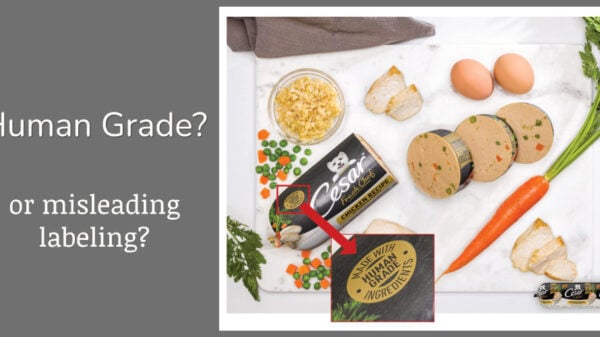
Manufacturing conditions: In 2017, the FDA inspected a Mars Petcare manufacturing facility in Columbus, Ohio as follow up to a Mars Cesar dog food recall that occurred 9 months prior. Found in the Freedom of Information Act requested FDA Inspection Report, the FDA found that Mars Petcare:
“1. Failure to inspect, segregate, or otherwise handle raw materials and ingredients used in manufacturing under conditions that will protect the animal food against contamination and minimize deterioration.
2. Failure to take effective measures to exclude pests from your plant and protect against contamination of animal food by pests.”
The inspection report stated: “The failure to take adequate measure to exclude and prevent pests from the manufacturing and related areas of the firm poses a significant public health safety concern while also being a regulatory violation.”
Many human food production facilities that produce human grade pet food have a USDA inspector on-site during all production activities. Contamination of ingredients, deterioration of ingredients, and contamination of the manufacturing facility by pests would NOT be permitted.
No…it is much more than a “marketing term”.
To the veterinarian that made the incorrect statement human grade pet foods are a “marketing term”, and to others that are ill informed about the quality of ingredients many pet foods contain – please wake up and smell the rotting decomposing animal carcasses. Read FDA’s own words, better yet – ask them yourself! Ask the FDA if they allow through enforcement discretion condemned animal material in (feed grade) pet food. Ask the agency if they have any science to evidence the safety of pets consuming diseased animals and animals that have died other than by slaughter on a daily basis. (Hint: they don’t – I asked.)
We need our veterinarians to be better informed about feed grade pet food ingredients, to understand the significant differences between feed grade and human grade.
Three cheers for the growing number of veterinarians that understand quality of pet food ingredients is significantly important to pet health.
Susan Thixton
Pet Food Consumer Advocate
TruthaboutPetFood.com
Association for Truth in Pet Food
Find Healthy Pet Foods in Your Area Click Here

The 2026 List
Our trusted ‘list’ of pet foods. Click Here to learn more.

The 2025/26 Treat List
Susan’s List of trusted pet treat manufacturers. Click Here to learn more.

Association for Truth in Pet Food is a stakeholder organization representing pet food consumers at AAFCO and with FDA. Your membership helps representatives attend meetings and voice consumer concerns with regulatory authorities. Click Here to learn more.





Cassandra
May 8, 2026 at 12:28 pm
Our pets were healthier when ‘table scraps’ was the only option, no cancer, diabetes, liver/kidney/organs failure, etc.
Thank you TAPF for your dedication!
T Allen
May 8, 2026 at 1:36 pm
Absolutely! As indicated by the length of time they lived and lived without diseases, like cancer, diabetes and thyroid issues!
Tom Kirby
May 8, 2026 at 4:00 pm
There are ingredients that cats need, in particular, that will never occur in your “table scraps.”
Julie
May 8, 2026 at 1:27 pm
Susan, thank you for a thorough and comprehensive post. The time you must have invested to write this is so appreciated. Thank you for your decades of educating us and fighting the good fight!
T Allen
May 8, 2026 at 1:40 pm
Excellent summary Susan! Thank you! I hope all your readers share this widely!And just a side note… feeding human grade is expensive but adding appropriate table scraps to commercial feed will help improve your pets health immensely while cutting back every mouthful of potentially toxic waste in the bag/can.
Brian
May 8, 2026 at 3:10 pm
Not a criticism of the article or the work Susan does, it’s truly yeoman’s work. However, I feel some context needs to be added here. Do not gloss over my comment and think that I am justifying the use of poor-quality ingredients or the consumption of things that should never be consumed.
Terms like “human grade” don’t always tell the whole story when comparing pet foods.
Some of the things that can be hugely beneficial for our pets are not considered “human grade” at all. Unbleached green tripe, fur, feathers, and many organs outside of liver and kidney would all fall into that category. I want those things in my dogs’ diets because they are species-appropriate and nutritionally valuable.
There are also companies that may not carry a certified “human grade” label, but who source thoughtfully, work with trusted suppliers they’ve known for years, and put a tremendous amount of care into ingredient quality and handling. Those things are harder to measure and don’t always show up in marketing language or on a website, but they still matter.
We have to be careful about how these conversations are presented to pet parents, because most people are not deeply versed in the world of pet food and often end up viewing things through a very narrow lens shaped by influential personalities, marketing, and simplified talking points online.
We’ve already seen how heavily the kibble industry has shaped consumer perception through creative marketing terms and buzzwords, and the healthy/holistic space can unintentionally fall into the same trap.
When that happens, pet parents can end up making decisions based more on labels, catchphrases, and emotional reactions than on a thoughtful evaluation of sourcing, formulation, ingredient purpose, and species-appropriate nutrition. The result is that some genuinely good feeding options get pushed out of the conversation simply because they do not fit neatly into a popular marketing category.
Susan Thixton
May 8, 2026 at 3:28 pm
I agree with you, with the exception of human grade being a ‘popular marketing category’. But…pet owners have no way to verify the quality of ingredients used in the pet foods you are referencing. I know they are out there, I know many companies follow human food safety manufacturing standards and source 100% human edible or in the example of tripe or organs humans don’t typically consume – they are sourced from USDA inspected and passed animals. But the struggle for pet owners is how do they verify the quality?
Brian
May 10, 2026 at 3:22 pm
It is very difficult for pet parents to verify quality. Honestly, it’s hard enough for us to verify quality with our own food sometimes, but that’s probably a separate conversation.
And to clarify my point, I don’t think “human grade” is inherently bad or intentionally deceptive. My concern is that it can easily become a marketing shortcut in consumers’ minds, even when that was not the original intent.
If pet parents are repeatedly told or shown that “human grade” equals the gold standard, many will naturally begin filtering foods through that lens alone.
That’s really the point I was trying to make. We all tend to assume we are speaking to Pet Parent 2.0, the deeply researched consumer who understands nuance and context, but in reality, most people are probably more like Pet Parent 1.2. They work all day, love their pets, want to do better, and often rely on simplified messaging to guide their decisions.
That’s why I think context matters so much in these conversations. Not because “human grade” is meaningless, but because many pet parents may not realize there are other important ways to evaluate quality and appropriateness beyond a single label or certification.
Tom Kirby
May 8, 2026 at 3:59 pm
This is an important post. As more and more companies who have historically offered human grade pet foods get bought out by big corporations, it’s important to keep an eye on this. A new owner will probably move away from human grade to save money, but the products will be far inferior to what they offered before.
B
May 8, 2026 at 4:02 pm
I have had dogs for my entire life. In the past, they got many different brands of kibble- All feed grade. Current dogs get human grade food. If I was wiser, I wouldn’t have fed feed grade. Human is more expensive, but I feel it’s the right way to go. Noting the one recall in 2013 of a human grade product, I feel safer than the millions of pounds of feed grade products that have been recalled. My dogs are healthy and I am happy to keep them that way. No feed grade for this family.
lr1230@metrocast.net
May 8, 2026 at 8:40 pm
Excellent information. The problem is that human grade food is so expensive.