






Recently, the Center for Science in the Public Interest (CSPI) published an article titled “Can Pet Food Make You Sick? Here’s How to Stay Safe”. The article was disappointing, at best.
The author starts off stating “Pet food isn’t just a risk for pets. It can also expose people to harmful bacteria.” True…but…
The author then points fingers at one style of pet food they claim is the riskiest. “Raw pet food poses the greatest risk.”
“Raw pet diets are often marketed as more ‘natural,’ but they carry a higher risk of harmful bacteria.”
They base this claim on a study performed by the FDA from October 2010 through July 2012.
“In a two-year study, the FDA’s Center for Veterinary Medicine tested more than 1,000 pet food samples, and raw dog and cat food stood out. Of 196 raw pet food samples, 15 tested positive for salmonella and 32 tested positive for listeria. By comparison, just one dry cat food sample tested positive for salmonella.”
But…the facts about the risk of harmful bacteria in pet food tells a very different story. During the time frame of the FDA testing (2012) where the agency claims it only found “one dry cat food sample” tested positive for Salmonella, Diamond Pet Food recalled more than 60 million pounds of dry pet food for Salmonellla contamination. This dry pet food recall resulted in 49 human illnesses, 10 individuals were hospitalized.
In late 2023, a dry pet food recall from Mid America Pet Food resulted in 7 human illnesses and 1 hospitalization. The FDA Enforcement Report stated 9,508,943 bags of pet food were recalled, an estimated 190,303,860 pounds.
Has the CDC confirmed any human illness to raw pet food?
The ONLY mention of human illness linked to raw pet food on the CDC website is with the 2017 – 2019 outbreak of Salmonella linked to raw turkey products (not solely turkey pet food). The CDC website states: “Among 198 interviewed patients, 132 (67%) reported direct or indirect contact with turkey in the week before illness; 123 reported preparing or eating turkey products that were purchased raw (including whole turkey, turkey pieces, and ground turkey), four became sick after pets in their home ate raw ground turkey pet food, and five worked in a facility that raises or processes turkeys or lived with someone who worked in such a facility. No common type, brand, or source of turkey was identified.”
Although four people became sick linked to “raw ground turkey pet food”, the CDC website does not clarify if the pet food was a commercial pet food or home prepared.
Total human illness linked to pet food:
Kibble = 56 people,
93% of all pathogenic bacteria human illnesses linked to pet food.
Raw = 4 people,
6% of all pathogenic bacteria human illnesses linked to pet food.
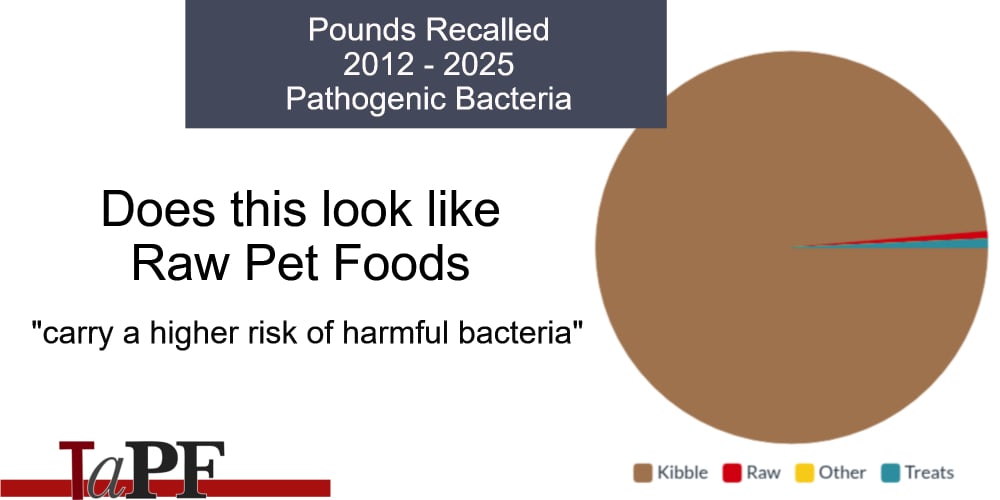
Total Pounds Recalled
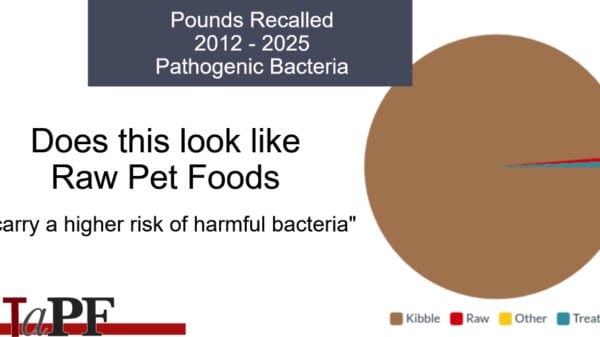
From January 2012 through December 2025 – 352,712,936 pounds of pet food has been recalled for pathogenic bacteria. Of these pounds of pet foods recalled for pathogenic bacteria – 98.6% was for kibble pet food. Raw pet food on the other hand was responsible for 0.59% of the total pounds recalled for pathogenic bacteria.
The breakdown of these 352 million recalled pounds of pet food per style:

Does this look like raw pet food products “carry a higher risk of harmful bacteria” as the CSPI states?
Shame on you Center for Science in the Public Interest. Your story misleads the pet owning public perhaps into complacency when handling kibble pet food. Very disappointing.
(We sent an email to the CSPI expressing our disappointment in this story, but we have not received a reply.)
Susan Thixton
Pet Food Consumer Advocate
TruthaboutPetFood.com
Association for Truth in Pet Food
Find Healthy Pet Foods in Your Area Click Here

The 2026 List
Our trusted ‘list’ of pet foods. Click Here to learn more.

The 2025/26 Treat List
Susan’s List of trusted pet treat manufacturers. Click Here to learn more.

Association for Truth in Pet Food is a stakeholder organization representing pet food consumers at AAFCO and with FDA. Your membership helps representatives attend meetings and voice consumer concerns with regulatory authorities. Click Here to learn more.



HFH
April 27, 2026 at 2:08 pm
Most interesting considering the latest from the AVMA. This info on dogs:
Key Findings on Kibble Feeding:
Adoption Rates: Research shows 81% of surveyed dog owners use kibble as the primary component, while 37.7% of owners use it exclusively.
Demographics: Larger dogs and households with more people tend to feed kibble more often, whereas smaller dogs and older owners are more likely to use wet or, in some cases, fresh food.
Alternative Diets: Only about 4% of owners rely on home-cooked meals as the primary diet.
Feeding Amounts: Standard recommendations for adult dogs often suggest 2%–3% of their ideal body weight, though this varies significantly based on activity level and the caloric density of the kibble.
Usage Patterns: Kibble is often chosen for its convenience, longevity, and lower cost compared to other diets.
[American Veterinary Medical Association]
THANX as usual for all your work and contributions!!
Carole
April 27, 2026 at 3:41 pm
I’m wondering if veterinary schools approach nutrition for their future patients the same way medical schools do — minimal to no attention to the subject. Our vet knows much about medicine and drugs, but his office is full of kibble brands, C.E.T. chews (a chew that almost choked one of our dogs to death), flea treatments, etc. You know, the usual. We have limited veterinary resources on our mostly rural island, so it’s up to me to perform due diligence on “controversial” subjects like vaccines, nutrition, flea treatments, exercise (no more dog parks for our doggos), pretty much everything but actual medical issues. On the other hand, I did refuse to have our Doodle spayed until one y/o.
Thanks to Susan and her willingness to educate us, I feel much more confident in the way we keep our Chloe healthy.
👍
saint
April 27, 2026 at 7:36 pm
Yes, medical and health are opposites. The veterinary system is exclusively medical, just like the people medical. They have zero health training or education. It was designed that way intentionally. It’s a sick care system because it’s a sick cause system. They create their own recurring customers, at least the brainwashed ones anyway…
Sandy M
April 28, 2026 at 10:02 am
You definitely have to educate yourself. Thanks to Susan for being a lighthouse in the fog. We are subjected to so much propaganda! This article “How to Stay Safe” by the Center for Science in the Public Interest is just that. Our government banned propaganda after WW2 with the 1948 Smith-Mundt Act. Then it was brought back through Smith-Mundt Modernization Act of 2012. Lifting the ban allowed the federal government to run propaganda campaigns to the American people. It was brought to our congress by one Democrat and one Republican, passed by our congress and signed by the president. In a Democracy, our government is supposed to represent us.