








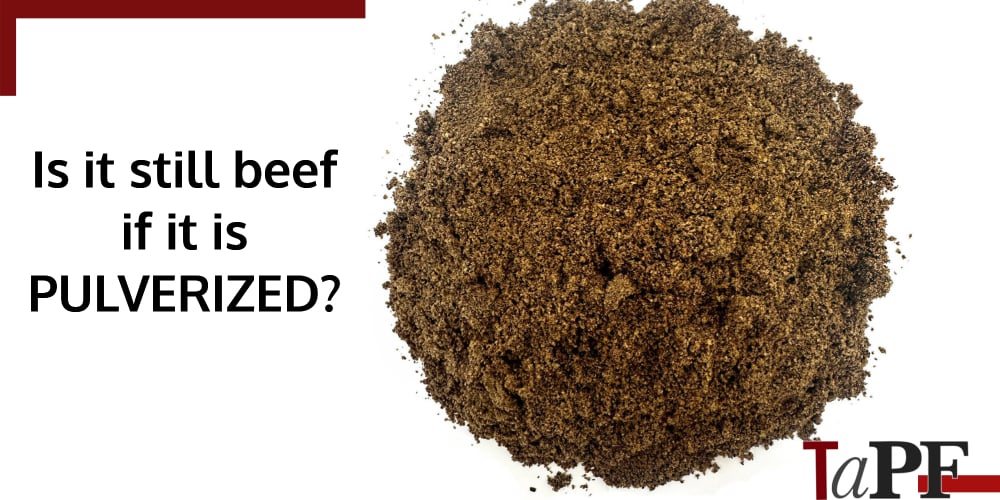
With many pet foods, we look at the product and see no visual clue that the ingredients listed on the label are actually in the pet food. Nothing looks like chicken, nothing looks like beef or pork.
How do they do it? Ingredients are pulverized. Pulverized chicken, beef, pork and all other ingredients.
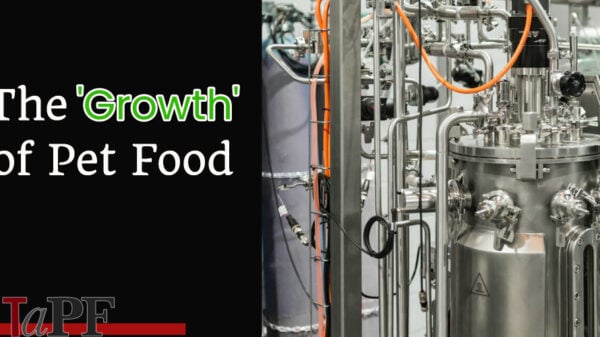
Some pet food ingredients are ground, some are subjected to the very industrial process of pulverizing. Grinding produces coarse to medium particles (ground beef). Pulverizing is a more intense industrial process that results in an ultra-fine powder or dust-like consistency.

From the Pet Food Pulverizer Market report: “Ingredient processing in pet-food manufacture increasingly requires pulverization to achieve consistent particle size for binding, digestibility and nutritional uniformity.“
Pulverizing equipment is used “to achieve uniform texture, enhanced digestibility, and stable extrusion performance, ensuring consistent nutrient distribution in both dry and wet formulations.”
“The hammer mill pulverizer segment holds the leading position in the pet food pulverizer market, representing an estimated 64.0% of total market share in 2026. Hammer mill pulverizers are widely used in pet food manufacturing due to their efficiency in reducing raw material particle size, uniform grinding performance, and adaptability to various feed formulations. These machines operate by repeated impact of hammers on ingredients, producing consistent granulation that supports better mixing and extrusion in downstream processes.”
Is there a nutritional difference between ground ingredients and pulverized ingredients?
From a hammer mill pulverizer manufacturer: “Hammer mills generate heat due to friction, which may lead to the degradation of certain heat-sensitive nutrients.”
Ingredients are classified as processed or ultra-processed depending on how much the original food is broken apart/broken down; more refined particle size indicates more intense processing. As example a ground meat would be classified as processed, but a pulverized meat would be classified as ultra-processed.
The Mayo Clinic provides this advice (for humans) regarding powdered greens: “Powdered greens can help support a healthy diet but should not replace vegetables or fruits.”
Unfortunately, in many pet foods powdered ingredients completely replace meats, vegetables and fruits – consumed for a lifetime.
A study performed by Purdue University several years ago showed that by adding fresh vegetables to a (ultra-processed) kibble diet, prevented or slowed the development of cancer in Scottish Terriers.
Give your pet some whole foods daily.
Susan Thixton
Pet Food Safety Advocate
Author Buyer Beware, Co-Author Dinner PAWsible
TruthaboutPetFood.com
Association for Truth in Pet Food
Find Healthy Pet Foods in Your Area Click Here

The 2026 List
Our trusted ‘list’ of pet foods. Click Here to learn more.

The 2025/26 Treat List
Susan’s List of trusted pet treat manufacturers. Click Here to learn more.

Association for Truth in Pet Food is a stakeholder organization representing pet food consumers at AAFCO and with FDA. Your membership helps representatives attend meetings and voice consumer concerns with regulatory authorities. Click Here to learn more.




T Allen
April 7, 2026 at 12:34 pm
Just don’t feed kibble and you don’t have to worry about it. The more people that boycott the better.
Wanda
April 7, 2026 at 7:03 pm
I am in agreement, but how long do we wait for the FDA Feed section to take control of the manuafacturers?
Barbara Fellnermayr
April 7, 2026 at 2:05 pm
Not only does pulverizing the ingredients reduce the quality of the ingredients, it makes them unrecognizable. They can pulverize anything and you wouldn’t know what it was to begin with.
The bigwigs at these companies should be forced to eat what they make.
Peg
April 7, 2026 at 3:35 pm
Why not just sweep the floor and throw that in the food? Probably more nutritional value
R
April 12, 2026 at 8:11 am
“Ingredients are classified as processed or ultra-processed depending on how much the original food is broken apart/broken down” – actually this is incorrect, and an oversimplification – technically pulverised beef would fall into either class 1 or 2 of the NOVA system. As no additional or excess fats or sugars are added in the process.
The NOVA system does not account for nutrient losses.
Is there a nutritional difference? No, not significant enough to be making somewhat misleading claims.
I thought you said you were not a nutritionist?
you also did not mention “Results suggest that consumption of certain vegetables may prevent or slow the development of TCC in Scottish Terriers.” – the word ‘may’ is important here.
In fact this study doesn’t make any specific claim that Kibble causes any form of cancer in the first place. nor does it mention ‘ultra-processed’ and link that to an increase in risk.