





Invasive blue catfish have become a problem for the Chesapeake Bay ecosystem. With support from the big pet feed trade associations Pet Food Institute and Animal Feed Industry Association, the House of Representatives just passed a bill that plans to dispose of (not suitable for human consumption) blue catfish into pet food.
The problem for pets with invasive blue catfish.
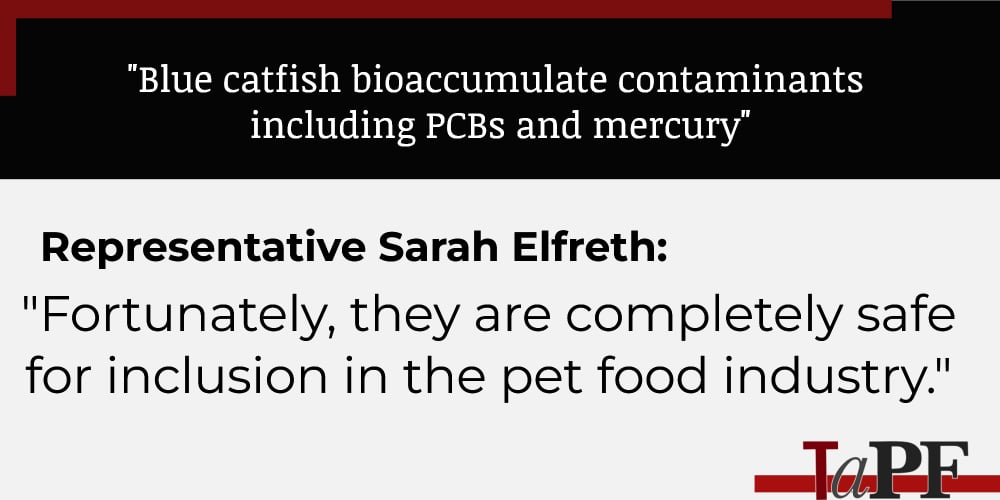
According to the Maryland Department of the Environment, “Blue catfish bioaccumulate contaminants including PCBs and mercury that result in advisories for human consumption, especially for larger catfish (> 30 inches).”
“Research has shown that blue catfish can live a long time in the Bay and can accumulate toxins in their bodies – therefore we recommend that consumers avoid fish larger than 30 inches, unless the “fatty meat” is removed. Removal of this “dark meat” or belly flap can reduce PCBs by an estimated 80%. Pollutant concentrations vary among rivers and lakes, so consumption advisories are given for specific locations within the Chesapeake Bay watershed.”
Smaller, young fish are not considered a human consumption risk – but it depends on the area the fish was caught in. For example the Maryland Department of the Environment states there is no limit to the amount of 15” to 24” blue catfish caught in the Choptank River an adult can consume, but fish caught in the Anacostia waterways should never be consumed regardless of size. In all areas, authorities do not suggest human consumption of blue catfish over 30” due to accumulated toxins.
Representative Sarah Elfreth told WTOP News (bold added): “This means there are tens of millions of fish over 25 pounds, or up to 85 pounds, actually, that watermen struggle to sell because they cannot be processed for human consumption, and the market is not there. Fortunately, they are completely safe for inclusion in the pet food industry.”
Completely safe?
How could the fish be considered “completely safe for inclusion in pet food” when authorities have long determined that fish from certain areas are full of contaminants and fish over 30” are full of contaminants?
Did the pet feed industry convincingly tell members of Congress that dogs and cats have magical protection against PCBs and mercury contamination?
Do members of Congress actually believe the known risks of these fish to humans and children are of no risk to pets?
Or are members of Congress simply repeating what is commonly done to our pets through pet food…we have some inedible waste we need to dispose of, industry needs to sell it – can’t let industry lose money, solution: sell it to pet food.
What you can do:
If your pet’s food contains catfish (whole fish, not the rendered ingredient fish meal), ask the manufacturer if they can assure you the fatty meat of the fish has been removed (the part of the fish that contains majority of the toxins). If your pet’s food contains a fish meal ingredient, ask the manufacturer if they can assure you the fish meal contains no catfish. (A rendered ingredient is most likely to contain whole fish, large fish not used for human food, and any byproducts such as the dark meat.) If your pet’s food contains any fish ingredient, ask the manufacturer if they perform contaminant testing on each batch of fish received.
Although this blue catfish issue is only one part of a bigger picture of waste disposal into pet food (with no disclosure to consumers), the bill has yet to pass the Senate. Pet owners are encouraged to write their Senate representatives asking them to publicly evidence the safety of blue catfish in pet food or do not pass the bill.
Susan Thixton
Pet Food Safety Advocate
Author Buyer Beware, Co-Author Dinner PAWsible
TruthaboutPetFood.com
Association for Truth in Pet Food
Find Healthy Pet Foods in Your Area Click Here

The 2026 List
Our trusted ‘list’ of pet foods. Click Here to learn more.

The 2025/26 Treat List
Susan’s List of trusted pet treat manufacturers. Click Here to learn more.

Association for Truth in Pet Food is a stakeholder organization representing pet food consumers at AAFCO and with FDA. Your membership helps representatives attend meetings and voice consumer concerns with regulatory authorities. Click Here to learn more.



Scrappyrat
April 1, 2026 at 12:04 pm
Does this mean it can be used even in human-grade cat food? I have several lovely rescued cats (they appear to be Japanese Bobtails. They were found abandoned with a large number of others who also appeared to be of the breed) who are allergic to poultry and have shown problems when fed mammals as well. So now we have fish and more fish, pretty much that they can eat with getting all scabby and having their fur fall out in clumps because they itch so badly (it’s heartbreaking to see them so uncomfortable). I can’t tell you how hard it is to find even human-grade cat food that doesn’t contain poultry. Even when things say “limited ingredients” they toss a little bird in there. They throw bird bits into everything. I even tried Smalls, but there must have been cross-contamination, because it triggered their allergies. I would make my own, but I have a serious chronic pain condition that makes it hard enough just to exist now. Thanks for any input.
Susan Thixton
April 1, 2026 at 12:08 pm
Yes, I assume so. You will need to ask your manufacturer about the fish they use.
Carol Chakeropulos
April 1, 2026 at 1:23 pm
Hi Scrappyrat.
Just wanted to share with you information about the best pet food on the planet- Evermore Pet Food. They have a new line of cat food for you and your furbabies. I am like you. I used to make all my own homemade dog food but now I have health issues and pain that prevents me from doing it anymore. I found “Evermore” through Susan’s list which checks all the boxes. I have been feeding that food for quite a while now and it is simply the best. I hope this helps. Check out the cat food that they deliver. Great customer service and quick delivery. Take care. Carol
Bonnie S Morris
April 1, 2026 at 12:25 pm
Exactly what is it the pet food industry wants from us? Carte blanc to freely poison our pets. Why would they want to do this. I do not understand their reasoning. I will NEVER prchasy any products that these companies produce. My question now is where to find a list of ALL products they make so I can put them on my NEVER BUY AGAIN LIST.
Susan Thixton
April 1, 2026 at 12:38 pm
The Pet Food Institute and the American Feed Industry Association were in support of this bill. PFI membership can be found here: https://www.petfoodinstitute.org/about-us/members/. The AFIA does not publicly disclose it’s membership.
Zac
April 1, 2026 at 12:50 pm
That post was for just Maryland.
Now look at Kentucky.
https://eec.ky.gov/Environmental-Protection/Water/Monitor/Pages/Fish-Advisories.aspx
Statewide Guidance
The guidance below applies to specific groups of fish from all Kentucky waters:
Species General Population Sensitive Population Contaminant
Predatory fish 1 meal per month 6 meals per year Mercury
Bottom feeder fish and Panfish 1 meal per week 1 meal per month Mercury
All other fish No Advisory 1 meal per week Mercury
Note: one meal is considered to be an 8 oz. serving for a 150 pound person.
Sensitive Populations: Women of childbearing age and children 6 years and younger are advised to eat no more than six meals per year of predatory fish and no more than one meal per month of panfish and bottom feeder fish. The general public is advised to eat no more than one meal per month of predatory fish and no more than one meal per week of panfish and bottom feeder fish.
Predatory fish include: Largemouth Bass, Smallmouth Bass, Spotted Bass, White Bass and Striped Bass and their hybrids, Yellow Bass, Flathead Catfish, Blue Catfish, Musky, Sauger and Walleye and their hybrids, Bowfin, Chain Pickerel and all Gars.
Panfish include: Bluegill, Green Sunfish, Longear Sunfish, Redear Sunfish, Rock Bass, and Crappie species.
Bottom feeder fish include: Channel Catfish, Drum, Carp Sucker, White Sucker, Common Carp, Bullhead species, Northern Hog Sucker, Buffalo species, Spotted Sucker, Redhorse species, Sturgeon and Creek Chub.
Other fish include: Asian Carp, Trout species, Minnows, etc.
CB
April 1, 2026 at 4:20 pm
It’s very similar in Washington State.
https://doh.wa.gov/community-and-environment/food/fish/advisories/publications
It’s both fresh and salt water regions due to mercury, PCBs, DDT,PFOS.
Plenty of only eat once a week or once a month and don’t consume any other fish that week. Don’t eat anything from certain waterways.
Statewide advisory against eating Northern Pikeminnow.
anna
April 1, 2026 at 1:12 pm
Follow the money. Good start: OpenSecrets.com.
Politicians don’t read, don’t think. Lobbyists do the heavy lifting, including writing the future laws plus the “checks for campaign contributions” for lawmakers. Politicians usually don’t even read the laws they pass.
Controlling and disposing of these fish would be very expensive. Why not two birds with one stone? Getting rid of the fish AND making money.
Please stop expecting science, common sense or an intact moral compass. Pets don’t vote. Their owners may and if they do they mostly believe the lies (which are legal by the way) they are told during election campaigns. Stop believing that we, the peasants, matter. We do not. Period.
Sandy M.
April 1, 2026 at 3:02 pm
Done. I wrote my Senator the following e-mail “I just heard about The Mitigation Action & Waterman Support (MAWS) Act, a proposed bill (passed by the House as
of March 2026) that incentivizes the use of contaminated blue catfish in
pet food.
This blue catfish issue is only one part of a bigger picture of waste
disposal into pet food (with no disclosure to consumers), the bill has
yet to pass the Senate.
PLEASE DON’T JUST AUTOMATICALLY PASS THIS BILL!
Please ask them to provide evidence of the safety of blue catfish in
pet food or do not pass the bill.
Thank you for listening. I’m counting on you!”
Locate your Senator and ask for their help. It’s worth a shot. It takes a village. . .
Susan Thixton
April 1, 2026 at 3:37 pm
Thank you Sandy for writing!
CB
April 1, 2026 at 5:18 pm
I absolutely cannot believe it is safe for cats and dogs. There are known toxicity levels for lead and mercury in many animals.
More specific research needs to be done to establish dangerous levels for our pets. And that work should not be done by any organization related to pet food manufacturing or sales.
Off to send my senators an email. Will I get a reply this time? Likely not.