









A new lawsuit filed in California discusses some significant concerns about human food, specifically Ultra Processed Foods (UPF).
Quoting the lawsuit (bold added for emphasis):
“In 1999, in Minneapolis, an executive climbed the dais in front of his fellow executives and begged them to change.”
“There are no easy answers,” he said. “But this much is clear: For those of us who’ve looked hard at this issue, whether they’re public health officials or staff specialists in your own companies, we feel sure that the one thing we shouldn’t do is nothing.”
“The executive wasn’t the head of a health insurance company, drug company, car manufacturer, or firearms company. His name was Michael Mudd, and he was the Vice President to the predecessor of Kraft Heinz, a conglomerate best known for making food products such as bright red ketchup and electric yellow macaroni and cheese. He was speaking to his peers that day in 1999 about the devastating consequences of developing and marketing ultra-processed foods (“UPF”) to Americans—and to children in particular.”
“After months interrogating scientific data with a colleague, Mudd spoke about the ‘devastating public health consequences’ of UPF consumption. He noted that the UPF industry had caused childhood obesity rates to double, that health conditions caused by consumption of ultra-processed foods were costing up to $100 billion a year, and, incredibly, causing 300,000 Americans to die each year.”
“Yet, despite his pleas—and despite the devastating statistics he shared—his colleagues, many of them executives of the defendant companies, were entirely unmoved. If anything, they were emboldened. They knew that their companies were designing, selling, and distributing harmful foods—and relentlessly marketing those foods to children. They knew that doing so was wreaking havoc at every step, and they didn’t care.“
I have personally witnessed many similar events at AAFCO meetings over the years – but this one was the worst…
The discussion was regarding the livestock feed ingredient “Recovered Retail Food”. The discussion provided the example of yogurt cups, such as those six packs of yogurt sold in your grocery. It was explained/discussed that when these types of foods expire, the products are collected in large bins behind every grocery. Expired yogurt, breads, meats, whatever – including plastic containers – are collected, ground and included in ‘feed’ for livestock.
A veterinarian in attendance of the meeting – Dr. Cathy Alinovi – questioned the pet food regulatory authorities who were about to approve this feed ingredient. Dr. Alinovi went to the microphone and stated her concern of plastic elements being in the feed – that animals such as dairy cattle would be consuming. She stated to the committee ‘I don’t want my daughter drinking milk with phthalates (plastic chemicals) in it.’
In response to her science based statement – the entire room – 400 or so representatives of industry, FDA, and State Feed Officials – boo-ed her. Loudly.
This scientist alerted industry and authorities to a risk of their proposed feed ingredient – and just like the human food meeting discussed in the lawsuit – they did not care about the risk.
Another quote from the human food lawsuit (bold added): “This case is not about food that is merely ‘unhealthy.’ This case is about food products with hidden health harms, that Defendants designed to be cheap, colorful, flavorful, and addictive. This case is about food products whose ingredients and manufacturing processes interrupt our bodies’ abilities to function. It is about the Defendants—gigantic food conglomerates, all—who designed, manufactured, marketed, and sold these foods knowing they were dangerous for human consumption. Defendants did everything in their power to deprive consumers of an informed choice.”
The same can be said about (some) pet foods. Pet food – regulatory and industry – does ‘everything in its power to deprive consumers of an informed choice’. Two examples…
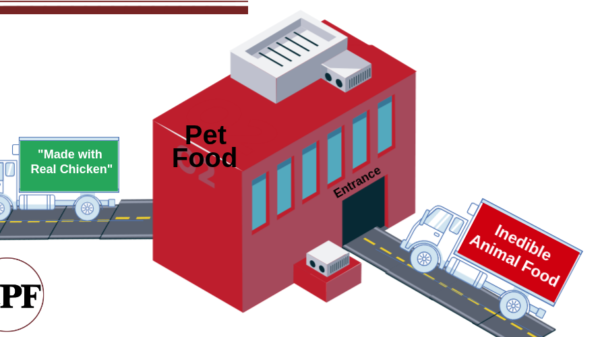
Every ingredient in pet food has its own legal definition that is often VERY different from the same ingredient in human food. As example the legal definition of human food chicken is required to be USDA inspected and passed. The same ingredient in a pet food – chicken – is NOT required to be USDA inspected and passed. Pet food chicken can be sourced from condemned chicken. All human food regulations/legal definitions are public information. To the contrary, all pet food/animal feed legal definitions are privately owned by AAFCO – NOT readily available for public access.
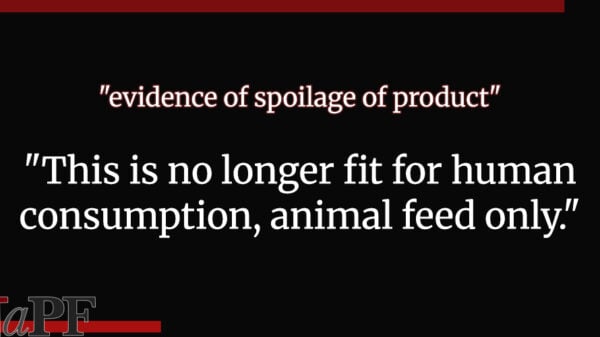
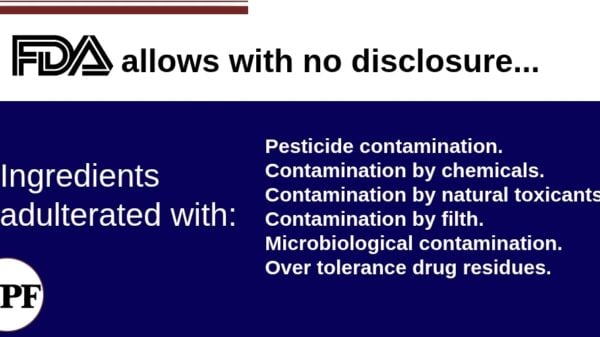
As well, the FDA quietly allows pet foods to violate federal laws – specifically allowing “diseased animals and animals that have died otherwise than by slaughter” into pet food (through “enforcement discretion”) while REFUSING to require manufacturers to disclose this quality of ingredient to consumers.
The human food brands being sued: The Kraft Heinz Company, (‘Kraft Heinz’); Mondelez International, Inc. (‘Mondelez’); Post Holdings, Inc. (‘Post Holdings’); The Coca-Cola Company (‘Coca-Cola’); PepsiCo, Inc. (‘PepsiCo’); General Mills, Inc. (‘General Mills’), Nestle USA, Inc. (‘Nestle’); Kellanova; WK Kellogg Co.; Mars Incorporated (‘Mars’); ConAgra Brands, Inc. (‘ConAgra’).
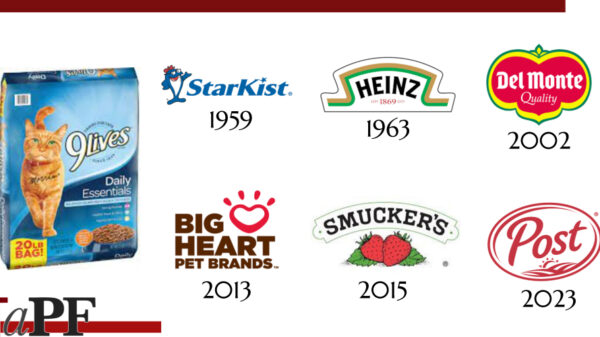
Interestingly, many of the brands involved also sell pet food.
This lawsuit involves Ultra Processed Foods (UPF), defined in the lawsuit as: ”they are formulations of often chemically manipulated cheap ingredients with little if any whole food added, made palatable and attractive by using combinations of flavors, colors, emulsifiers, thickeners, and other additives.”
“The consensus from the international scientific community is that UPF are uniquely dangerous to our health—no matter how healthy they may seem to the ordinary consumer or what nutritious value they may offer—because of their industrially-processed ingredients, including additives and synthetic chemical agents.”
The lawsuit also included information about a study performed on two groups of people, one group consumed ultra processed foods (UPF) and the other group consumed no UPF (whole foods); “the group that consumed UPF gained weight and fat mass, relative to the group that did not consume UPF—even though both groups consumed the same number of calories.”
We have to wonder if ultra processed pet foods are directly linked to insanely high cancer rates in pets, the obesity epidemic in pets, and so many other common health issues our pets are suffering from.
What are ultra processed pet foods?
The NOVA system is a food classification system “with its identification and definition of ultra-processed foods that has been most applied in scientific literature”. According to the NOVA system, human foods are classified into four groups:

How to distinguish between a processed and ultra-processed pet food.
With ingredients: “It starts with the fractioning of whole foods into substances including sugars, oils and fats, proteins, starches and fibre. These substances are often obtained from a few high-yield plant foods (such as corn, wheat, soya, cane or beet) and from puréeing or grinding animal carcasses, usually from intensive livestock farming.”
“Some of these substances are then submitted to hydrolysis, or hydrogenation, or other chemical modifications. Subsequent processes involve the assembly of unmodified and modified food substances with little if any whole food using industrial techniques such as extrusion, moulding and pre-frying. Colours, flavours, emulsifiers and other additives are frequently added to make the final product palatable or hyper-palatable.”
If we apply these ultra-processed food markers to pet food ingredients, the following ingredients would be classified as ultra-processed (compared to similar ingredients classified as processed):

Heating, pasteurizing, canning, and drying (air drying or freeze drying) are all considered forms of processing; extrusion is considered by NOVA as ultra-processing. Thus, extruded kibble pet foods would be classified as an ultra-processed food for pets.

We have hopes the attorneys representing the State of California consider a similar lawsuit against the pet food industry.
Susan Thixton
Pet Food Safety Advocate
Author Buyer Beware, Co-Author Dinner PAWsible
TruthaboutPetFood.com
Association for Truth in Pet Food
Find Healthy Pet Foods in Your Area Click Here

The 2026 List
Our trusted ‘list’ of pet foods. Click Here to learn more.

The 2025/26 Treat List
Susan’s List of trusted pet treat manufacturers. Click Here to learn more.

Association for Truth in Pet Food is a stakeholder organization representing pet food consumers at AAFCO and with FDA. Your membership helps representatives attend meetings and voice consumer concerns with regulatory authorities. Click Here to learn more.




Sandra
December 11, 2025 at 2:25 pm
If nothing else, the lawsuit (and hopefully win) will give any pet parent the counter argument to vets pushing their UPF wares or discouraging healthy options. In the meantime: pet parents, use this excellent article to fight for your animals. They pay with their health, you pay for the destruction of their health if you don’t stand up.
jan b=b
December 11, 2025 at 5:55 pm
my husband and I, both of us in our 80’s, have decided that food available now is nothing like what we grew up to eat! this article was really scary to read – it seems the corruption is not only in petfoods but in our foods as well. Who knew those labels we so carefully read may not be telling the whole truth.
Denise
December 11, 2025 at 6:12 pm
Thank you to Dr. Cathy Alinovi for speaking up and Susan Thixton for this informative article. It’s very sad that human and pet food industries, FDA, State Feed Officials, and others put profit over the health of their own families, other people especially children, and animals, including pets.