











AAFCO – the Association of American Feed Control Officials – is a private organization that does not regulate pet food, but writes the laws which regulate pet food and animal feed on a state level. Membership of AAFCO is limited to state and federal (FDA) regulatory authorities, but industry and consumers can participate (to an extent). AAFCO hosts two in person meetings a year (typically in August and January), in various locations around the US. The recent meeting was held in San Diego, CA.
The public meetings are broken down into sessions for different aspects of the regulation of pet foods and animal feeds. Below are some of our notes from different sessions.
During the Ingredient Definitions Committee meeting, a VERY telling discussion occurred. The topic was regarding one sentence in the definition of the pet food/animal feed ingredient Meat and Bone Meal. The full definition, with the sentence in question in bold:
“9.41 Meat and Bone Meal is the rendered product from mammal tissues, including bones, exclusive of any added blood, hair, hoof, horn, hide trimmings, manure, stomach and rumen contents, except in such amounts as may occur unavoidably in good processing practices. It shall not contain extraneous materials not provided for in this definition. It is a source of protein in animal diets. The total ash content for the product should contain a minimum of 28% ash. It shall not contain more than 12% pepsin indigestible residue** and not more than 9% of the crude protein in the product shall be pepsin indigestible**. The label shall include guarantees for minimum crude protein, minimum crude fat, minimum Phosphorus (P) and minimum and maximum Calcium (Ca). If the product bears a name descriptive of its kind, composition, or origin, it must correspond thereto. (Proposed 1985, Amended 1992, Published 1994, Amended 2025, 2026). IFN 5-00-388 Animal meat with bone rendered.”
The sentence in the definition discussed was the minimum ash percentage requirement. Some wanted that sentence removed, some wanted it to stay. Some in the discussion stated that this definition – meat and bone meal – was so similar to the legal definition of meat meal, the only difference between the two ingredients is the ash content. They even stated that if the ash minimum was removed (the bold font sentence above), a supplier could label meat meal as meat and bone meal if they wanted.
Why is this significant?
Meat Meal and Meat and Bone Meal are two different pet food ingredients. Meat and Bone Meal has historically been considered the lowest quality of rendered ingredient. It can contain whole carcasses of dead, diseased, decomposing animals. Note that the definition states “mammal tissues, including bones, exclusive of any added blood, hair, hoof, horn, manure…” The key words are “exclusive of any added…” This means hair, hoof, horn, and manure can be included in the ingredient sourced from each dead animal processed – the definition does not allow a supplier to add more (“exclusive of any added”) of this material.
Years ago, the FDA determined that meat and bone meal was the most likely pet food ingredient to contain pentobarbital. From the FDA website: “There appear to be associations between rendered or hydrolyzed ingredients and the presence of pentobarbital in dog food. The ingredients Meat and Bone Meal (MBM), Beef and Bone Meal (BBM), Animal Fat (AF), and Animal Digest (AD) are rendered or hydrolyzed from animal sources that could include euthanized animals.”
On the other hand, meat meal – such as beef meal – is touted as being a higher quality ingredient. Blue Buffalo pet food tells pet owners: “Beef meal is a protein source that supports muscle development and energy.”
Their open discussion about these two ingredients confirms industry and regulatory are well aware both are commonly sourced from the absolute worst quality of raw materials (dead, decomposing animals). Their discussion confirmed they only care about the words defining an ingredient, not the actual ingredient – whether it is legal or not (by the way it is not legal when sourced from dead decomposing animals or condemned animals), and whether it is quality nutrition or not.
During the Current Issues and Outreach Committee meeting they discussed “consumer education” was planned for this fall and early 2027. No details were provided to what AAFCO was planning to educate consumers on.
And also in this session, the committee spent a lot of time discussing a topic that should have been discussed in the Pet Food Committee session. They began a discussion of AAFCO’s Pet Food Label Modernization effort – specifically the requirement to disclose the percentage of dietary fiber on the label.
As background information, Congress required FDA to update pet food labels through Ensuring the Safety of Pet Food in 2007. Congress required FDA to complete these updates within two years (to be completed by September 2009). FDA did not complete this requirement, instead it appears they passed it off to AAFCO. AAFCO worked on the task for years, finally completing the updates in July 2023. But…the updates are not to be implemented until 2030.
Back to current day, the AAFCO Current Issues and Outreach Committee discussed the challenges of the dietary fiber disclosure that will be required on labels in four years. We were told that lab testing – to confirm the percentage of dietary fiber in a pet food – is not readily available, is not consistently accurate, and testing fails with high moisture pet foods (such as canned, raw, fresh).
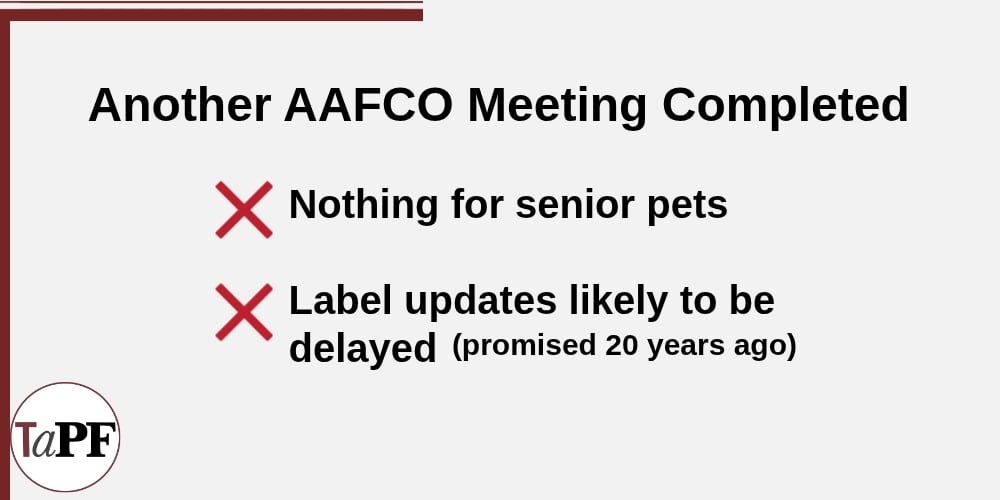
My thoughts at the time were…you (AAFCO) have had years to work out the details of this. Why is this just coming to light now? And then…an industry representative asked the committee if they could delay the dietary fiber requirement. Which gave me the answer. This is a way for industry to delay the pet food label updates that were promised to pet owners almost 20 years ago.
In the Pet Food Committee session, the discussion continued with more challenges to implementing pet food label updates.
Briefly, many states are hesitant to adopt into state law the AAFCO pet food label updates. As well, there was discussion that some manufacturers have learned the new labels would not be accepted in other countries (for manufacturers that export products).
In other words, the pet food label updates are facing many obstacles. It is unknown if the 2030 deadline will be met, or if we have to wait even longer for what we were promised by Congress in 2007.
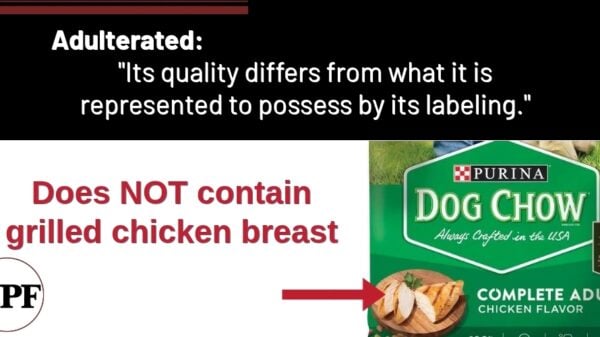
During this session AAFCO had speaker Todd Harrison from the law firm Venable who helps “clients resolve their most difficult regulatory challenges.” Mr. Harrison explained to the audience what law allows in pet food label claims, and almost seemed to warn some that it is just a matter of time before those misleading pet food label images of roasted chicken and grilled steak they currently use will be facing a lawsuit. This was one of his presentation slides:
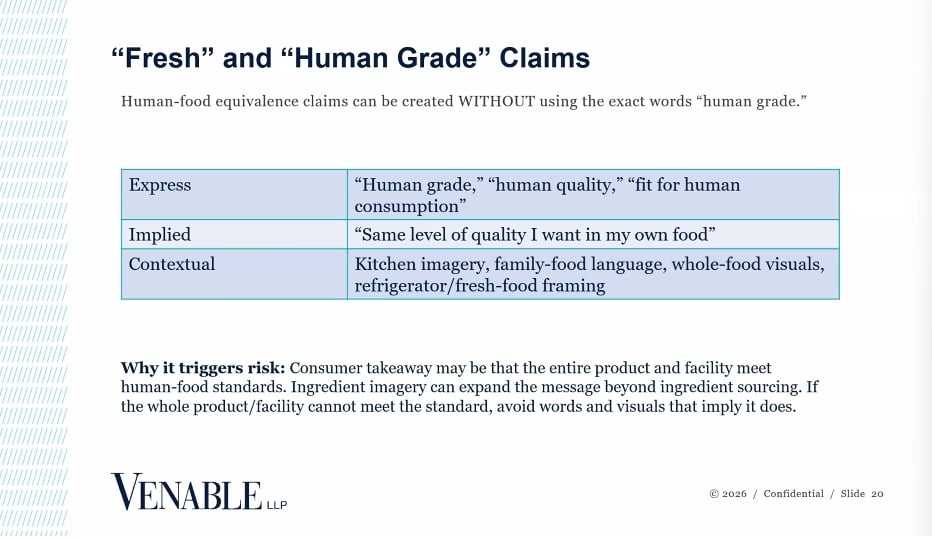
He explained that pet food manufacturers take a legal risk when “ingredient imagery” on labels (or websites) is not what the pet food is made from.
Also in discussion during the Pet Food Committee was a report from FDA regarding Senior pet diets. A request was made for AAFCO to develop a senior pet nutritional profile, to assure that senior pets – who consume less food due to being less active – would be receiving all of the required nutrients. The FDA representative even admitted that some veterinarians are instructing clients to feed a senior dog less food which could be resulting in nutrient deficiency. In other words, the FDA representative admitted this is a problem – but did not make any specific recommendation to AAFCO to fix the problem. Instead both FDA and AAFCO will continue to allow pet foods to be marketed for senior pets when they are no different than other pet foods. FDA and AAFCO will continue to allow industry to profit from deceiving consumers, will continue to allow senior pets to potentially suffer from nutrient deficiencies.
The next AAFCO meeting will be in January, held in Orlando, Florida.
Susan Thixton
Pet Food Consumer Advocate
TruthaboutPetFood.com
Association for Truth in Pet Food
Find Healthy Pet Foods in Your Area Click Here

The 2026 List
Our trusted ‘list’ of pet foods. Click Here to learn more.
The 2026/27 Treat List
Susan’s List of trusted pet treat manufacturers. Click Here to learn more.

Association for Truth in Pet Food is a stakeholder organization representing pet food consumers at AAFCO and with FDA. Your membership helps representatives attend meetings and voice consumer concerns with regulatory authorities. Click Here to learn more.



Sandy M.
August 28, 2026 at 3:50 pm
This lawyer speaks volumes in his warning, I hope pet food manufacturers are listening. The government collects taxes from us to enforce laws, but ultimately it’s the lawyers who force change through fear of a lawsuit or a judge who has to force the government to do its job. Too bad that government regulatory agencies have to be too close to the businesses they oversee and our pets suffer. Susan, thank you for keeping us informed and for all you do for our pets! From my perspective, your advocacy group is having impact.
sonyam123@gmail.com
August 29, 2026 at 2:27 pm
Susan, thank you for illuminating these problems.
this article is particularly
relevant, succinct, useful. I admire your tenacity, your intense care for companion animals’ lives, your technical knowledge.
A similar cozy relationship exists between a large aircraft manufacturer and FAA regulators, at the alleged cost of many lives.
No one has been criminally charged for worker or passenger deaths or disability.
Until executives, from many different fields, like finance, insurance,
travel, construction, tech, etc., do prison time, nothing will change.
if “corporations are people” why does no one go to jail???
The 2 pronged root cause is executive greed combined with
government dismissal of humans and animals, just for re-election.